
Stripping run and spirit run: why distil twice?
Most pot-still spirits are distilled twice: a fast stripping run to pull the alcohol out of the wash, then a slow spirit run where the cuts are made. Here's why the two runs are so different, how to run each, and how to plan them.
In short
- The stripping run is fast. It recovers nearly all the alcohol from the wash as low wines, without careful cuts.
- The spirit run is slow. It redistils the low wines, often from several washes, and is where the cuts are made.
- Two runs give a pot still the strength and separation that one run cannot, while keeping the wash's character.
- Dilute low wines to around 30–40% ABV before the spirit run, and add any feints from earlier runs.
Why distil twice?
A pot still gives roughly one stage of separation per run. From a wash of about 8–10% ABV, one run produces spirit of perhaps 25–35% ABV, with the fractions still heavily overlapping. Run that again and the strength roughly doubles, and the heads, hearts and tails separate far more clearly.
Splitting the work into two different runs is also efficient. The first run can be fast because nothing is being decided; the second can be slow and careful because the boiler holds concentrated low wines - the alcohol from several washes - rather than mostly water.
A reflux still does many stages of separation in one pass, so it usually needs only a single run. See pot still, reflux still or column?
The stripping run
- Purpose: get the alcohol out of the wash, quickly and completely.
- Heat: generous. Speed costs little, because separation isn't the goal.
- Cuts: none in the usual sense. Many distillers set aside a small foreshots fraction at the start; everything else is collected together.
- When to stop: when there is little alcohol left - commonly when the spirit coming off has fallen to around 10–20% ABV, or the boiler is approaching the boiling point of water at your air pressure. Going further collects mostly water.
- What you get: low wines, typically around 25–35% ABV, holding most of the alcohol from the wash.
Strain or rack the wash off its sediment first: solids scorch on an element and can foam into the still.
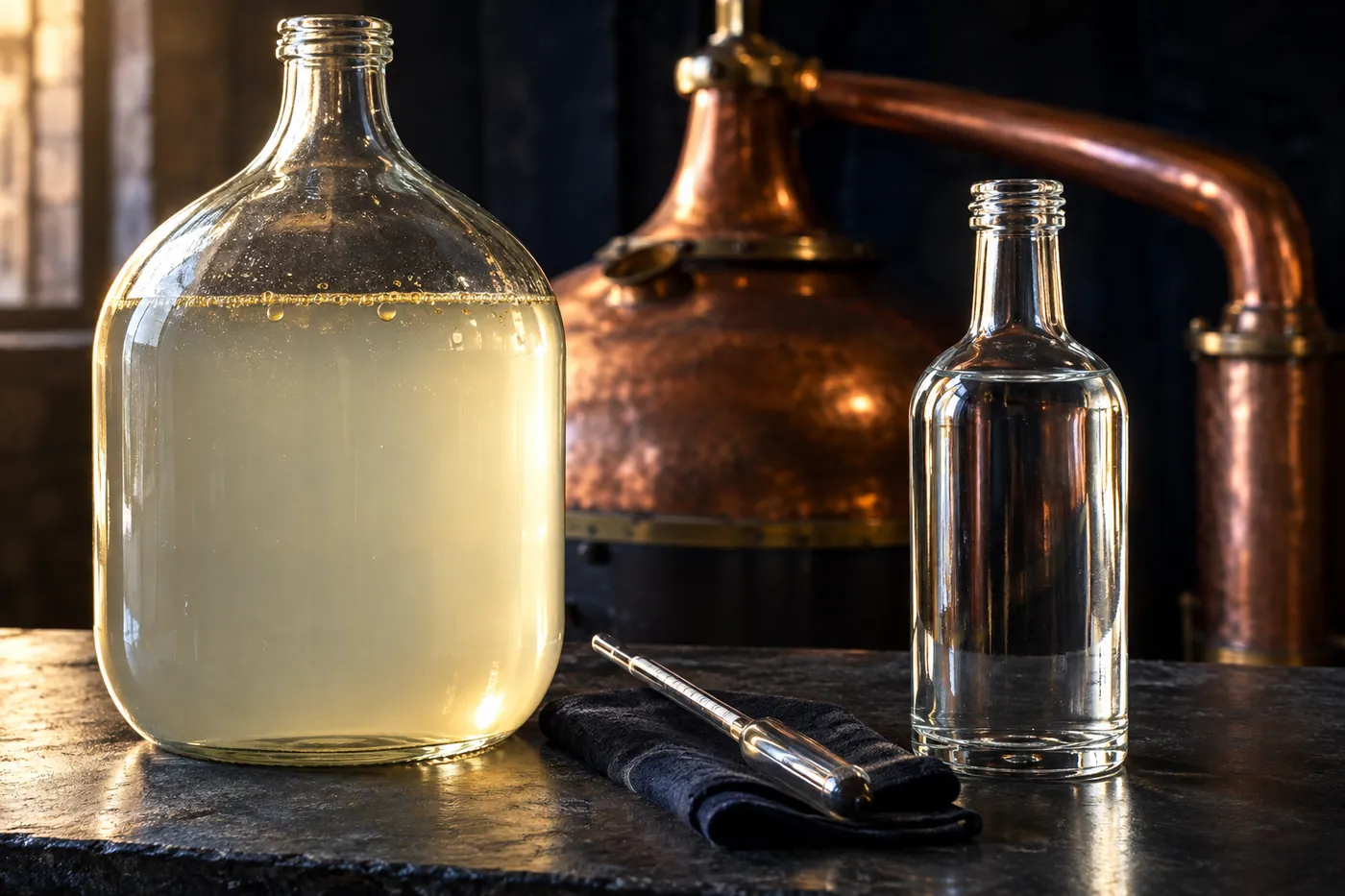
The spirit run
- Purpose: separate the heads, hearts and tails, and make the cuts.
- The charge: combine the low wines from several stripping runs, add any feints from earlier spirit runs, and dilute with water to around 30–40% ABV. A weaker charge separates more gently, and is less of a fire hazard than strong spirit in a hot boiler.
- Heat: gentle and steady, especially through the hearts.
- Collecting: discard the foreshots, then collect the run in numbered jars and decide the cuts afterwards. See making the cuts.
Side by side
| Stripping run | Spirit run | |
|---|---|---|
| Goes in | Wash, about 6–12% ABV | Low wines plus feints, diluted to 30–40% |
| Heat | Fast | Slow and steady |
| Cuts | Small foreshots cut, then collect everything | Foreshots, heads, hearts, tails |
| Ends when | Output weak; boiler near water's boiling point | Deep in the tails, as far as you want to collect feints |
| Comes out | Low wines, about 25–35% | Hearts, roughly 60–80% on a pot still |
Planning your runs
How many washes make a spirit run? Enter your wash and boiler, and the calculator estimates the low wines and how the spirit charge fits.
One-run alternatives
- A single pot-still run suits some traditional recipes, such as Uncle Jesse's Simple Sour Mash, accepting a lower strength and broader cuts.
- A thumper between boiler and condenser gives the effect of a second distillation in one run.
- A plated or reflux column does the separation of several runs in one.
Where Stilligent fits
Stilligent handles both kinds of run. On a stripping run it drives the heat for speed and stops at the end point; on a spirit run it holds gentle, steady heat, calls each cut for your recipe, and alerts you when it's time to change receivers.
From the forum
Questions, corrections or experience of your own? Share them in this guide’s topic on the Stilligent forum.
More guides
-
Proof and ABV, and how to measure your spirit
ABV, US and British proof, hydrometers and alcoholmeters, temperature correction - and calculators for proof, dilution and wash strength. 3 min read
-
Why a temperature chart can't tell you when to cut
Why stills don't follow the familiar boiling-point charts, what the head temperature really measures, and what it is good for. 5 min read
-
Distilling at altitude: how air pressure moves every boiling point
Why every boiling point falls as you climb, how much the weather moves it, and a calculator for your own elevation or barometer reading. 4 min read
Underlined terms are explained in the glossary - tap one for a quick definition.