
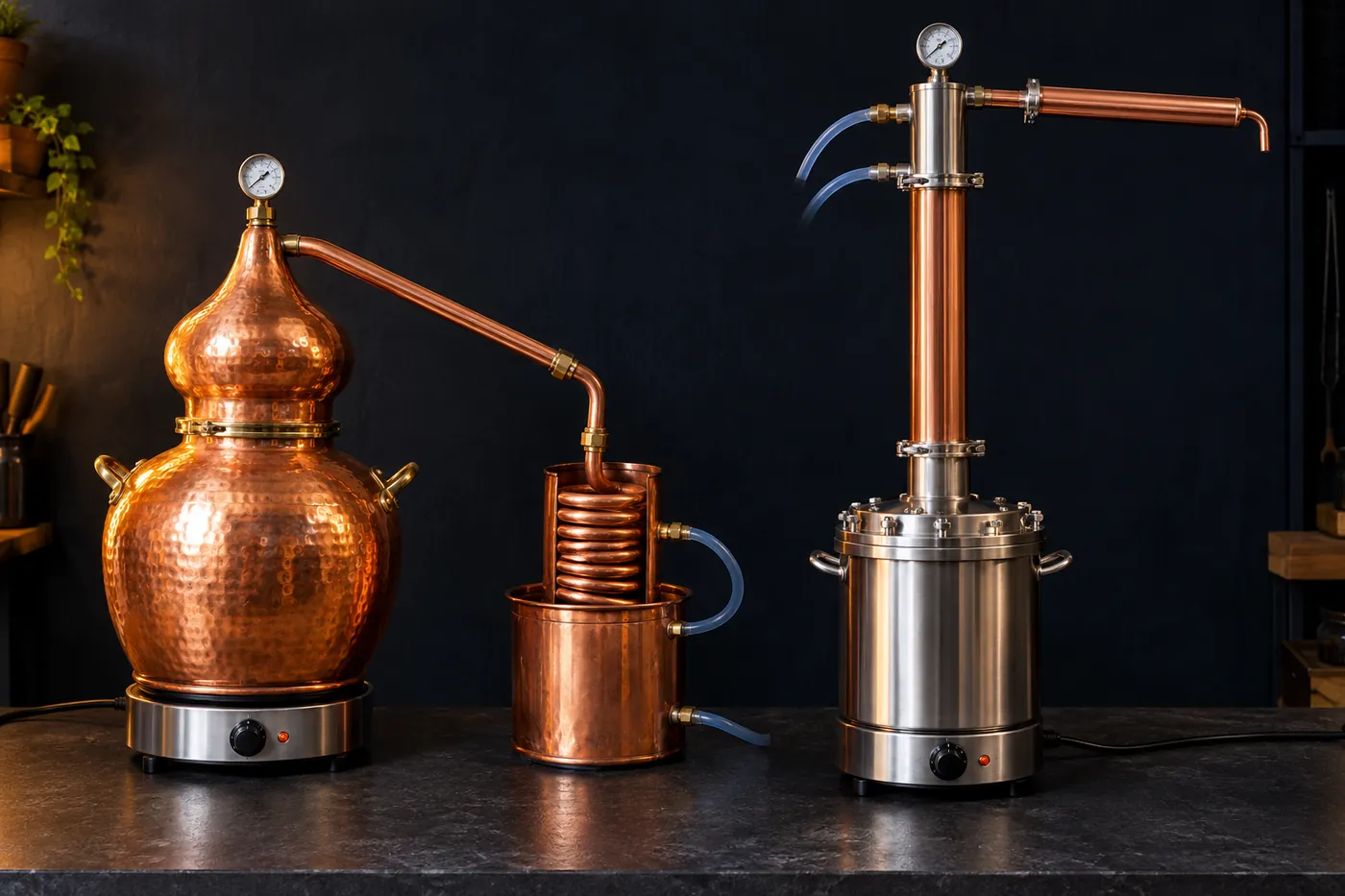
Pot still, reflux still or column: which is right for you?
Every still does the same basic job: boil, condense, collect. What differs is how much the vapour is refined on its way up - and that decides whether your spirit comes off full of character or clean and neutral. Here is how the main designs work, and how to choose between them.
In short
- A pot still separates gently. The spirit keeps the character of the wash - ideal for whiskey, rum and brandy - but usually needs two runs.
- A reflux still refines the vapour many times inside a column, producing a clean, strong, neutral spirit in a single run - ideal for vodka and gin bases.
- A plated column sits between them: a few plates give a stronger, cleaner spirit than a pot still while keeping much of its flavour.
- Many modern stills can be configured either way. Choose for the spirit you make most often.
The principle: how many times the vapour is refined
When a wash boils, its vapour is richer in alcohol than the liquid it came from. Condense that vapour and boil it again, and the result is richer still. Each boil-and-condense step is one stage of separation - what chemical engineers call a theoretical plate.
A pot still gives roughly one stage per run. A reflux column gives many: vapour rising through the column meets liquid running back down, and they exchange alcohol and other compounds again and again on the way. More stages mean a stronger, cleaner and more neutral spirit - up to the limit of the azeotrope, at about 96% ABV.
The pot still
A boiler, a short path for the vapour, and a condenser. Little or nothing refines the vapour on the way, so what comes out reflects the wash closely: its fruit, grain and character carry through.
- Strength: a single run of a typical wash gives low wines of around 25–35% ABV; a second run brings the hearts to roughly 60–80%.
- Cuts: the transitions are gradual, so the cuts are broad judgements - and that's where much of the craft lies. See making the cuts.
- Best for: whiskey, rum, brandy and other spirits made for flavour.
Some pot stills add a thumper (or doubler): a vessel between the boiler and the condenser in which the vapour bubbles through liquid, giving the effect of a second distillation in one run.
The reflux still
A tall column, packed with material that offers a large surface - such as stainless or copper mesh - or fitted with plates, sits on the boiler. At the top, part of the vapour is condensed and sent back down as reflux. The balance between what is returned and what is drawn off - the reflux ratio - sets how strong and clean the spirit is.
- Strength: commonly 90–95% ABV in a single run.
- Character: clean and neutral; most of the wash's flavour is left behind.
- Cuts: separation is sharp. The heads are concentrated early and the hearts run long and steady, but the tails arrive quickly once the column can no longer hold them.
- Best for: vodka, and neutral spirit for gin and liqueurs.
Ways of controlling the reflux
Home reflux stills are often described by how they control the draw-off:
- Vapour management (VM): a valve splits the vapour between the reflux and the product condenser.
- Liquid management (LM): all the vapour is condensed at the top, and a valve decides how much of the liquid is drawn off.
- Cooling management (CM): the amount of cooling at the top of the column decides how much vapour is returned as reflux.
The plated column
Instead of packing, the column holds a small number of plates - often three to six - each with a pool of liquid that the vapour bubbles through. Each plate acts roughly as one stage. With a few plates the spirit comes off strong and clean in one run while keeping much of the wash's character; many plated stills let you bypass or remove plates, so one still can behave more like a pot or more like a column.
- Strength: roughly 70–90% ABV in one run, depending on the number of plates and how they are run.
- Best for: flavourful spirits in a single run - whiskey, rum and brandy with a cleaner profile.
Side by side
| Pot still | Plated column | Packed reflux column | |
|---|---|---|---|
| Spirit strength | 25–35% (strip), 60–80% (spirit run) | About 70–90% in one run | About 90–95% in one run |
| Character | Full; reflects the wash | Clean, with much of the character | Neutral |
| Runs needed | Usually two | Usually one | One |
| Cuts | Broad, gradual | Sharper | Sharp; tails arrive quickly |
| Best for | Whiskey, rum, brandy | Flavourful spirits in one run | Vodka, gin base |
| Complexity | Simplest | Moderate | Moderate; needs steady control |
Typical figures; the actual strength depends on the wash, the still and how it is run.
How to choose
- Mostly whiskey, rum or brandy? A pot still - perhaps with a thumper - is the natural choice, and the simplest to run well.
- Mostly vodka and gin? A reflux column gives a clean neutral in one run. For gin, a pot still is then ideal for the botanical run - see Odin's Easy Gin.
- A bit of everything? A modular still - a pot with an optional column, or a plated column with removable plates - covers most needs.
Whatever you choose, steady heat matters: a reflux column in particular depends on a stable balance between heating and cooling. See your element isn't the power on the label.
Where Stilligent fits
Stilligent works with pot stills and reflux columns, for stripping and spirit runs. It knows how each behaves - the gradual changes of a pot still, the long plateau and sudden tails of a reflux column - and calls the cuts, shapes the heat and alerts you accordingly.
From the forum
Questions, corrections or experience of your own? Share them in this guide’s topic on the Stilligent forum.
More guides
-
Stripping run and spirit run: why distil twice?
Why pot-still spirits are distilled twice, how each run differs, and how many washes it takes to fill a spirit run. 3 min read
-
Proof and ABV, and how to measure your spirit
ABV, US and British proof, hydrometers and alcoholmeters, temperature correction - and calculators for proof, dilution and wash strength. 3 min read
-
Why a temperature chart can't tell you when to cut
Why stills don't follow the familiar boiling-point charts, what the head temperature really measures, and what it is good for. 5 min read
Underlined terms are explained in the glossary - tap one for a quick definition.