
Your element isn't the power on the label
A heating element marked 3,000 watts seldom delivers exactly that. Its real output depends on the mains voltage, which varies from place to place and through the day - and the difference shows up in heat-up times, take-off rates and the cleanness of your cuts.
In short
- An element's power rises and falls with the square of the voltage: 5% low voltage means about 10% less heat.
- Mains voltage varies with location, time of day and wiring, and an element rated at one voltage is often used on another.
- Less power means longer heat-ups and a slower, different run. Because some heat is always lost to the room, the effect on output is larger than the drop in power.
- A power setting in percent is a percentage of whatever the supply delivers that day. Heat measured in watts is repeatable.
- Measure rather than assume - the calculator below shows what to expect.
Why the label isn't the whole story
A heating element is a resistor. Its rating - say 3,000 W - holds only at its rated voltage. At any other voltage the power follows a simple law: power equals voltage squared divided by resistance. The resistance hardly changes, so the power changes with the square of the voltage.
Power follows the square of the voltage
Element rated 3,000 W at 230 V
| Supply voltage | Real power of a 3,000 W / 230 V element | Difference |
|---|---|---|
| 207 V | 2,430 W | −19.0% |
| 210 V | 2,501 W | −16.6% |
| 215 V | 2,621 W | −12.6% |
| 220 V | 2,745 W | −8.5% |
| 225 V | 2,871 W | −4.3% |
| 230 V (rated) | 3,000 W | 0.0% |
| 235 V | 3,132 W | +4.4% |
| 240 V | 3,267 W | +8.9% |
| 245 V | 3,404 W | +13.5% |
| 253 V | 3,630 W | +21.0% |
The same applies whichever voltage your element is designed for. An element rated 3,000 W at 240 V gives about 2,760 W on a 230 V supply; a 1,500 W element on a 120 V supply that sags to 114 V gives about 1,350 W. Manufacturing tolerances add a few percent either way, so two elements with the same label can differ before the supply is even considered.
How much does the mains vary?
More than most people expect. In much of the world the nominal supply is 230 V, and the standards allow it to stray 10% either way for most of the time - anywhere from about 207 to 253 V. In North America, the usual range for a 120 V supply is 5% either way. Within those limits, the voltage at your still depends on:
- Time of day. Voltage tends to sag at evening peaks, when demand is highest.
- Location. Homes at the end of long or rural lines, far from the transformer, often see lower voltages than those close to it.
- Your own wiring. A long or thin extension lead loses voltage under the heavy, continuous load of an element.
- Other supplies. Generators and inverters each have their own voltage, and may hold it less steadily.
Why it matters on a still
Heat-up time
Bringing 25 L of wash from 20 °C to the boil takes about 2 kWh of heat, before any losses. A true 3,000 W does that in about 40 minutes; 2,500 W takes about 48.
Take-off rate and separation
Some heat is always lost through the boiler and column to the room. Only what remains turns wash into vapour, so a drop in power hits the output harder than the power figure suggests. If, say, 500 W is lost, a 3,000 W element leaves 2,500 W for boiling; at 2,500 W, only 2,000 W remains - 17% less power, but 20% less vapour. The run is slower, and on a reflux still the balance between boil-up and cooling shifts with it.
Repeatability
Most power controls work in percent. Sixty per cent of a strong supply and sixty per cent of a weak one are different amounts of heat, so a recipe written in percent drifts with the voltage. A recipe written in watts means the same thing every time - as long as something measures the watts.
Measuring your element's real power
- Measure the resistance. With the element disconnected from the mains, a multimeter across its terminals gives its resistance. Real power is your supply voltage squared, divided by that resistance. The element's resistance rises slightly when hot, so treat the result as a close estimate.
- Use a plug-in energy meter for a plug-in element - but only one rated for the element's full current, which for a 3 kW element is around 13 A.
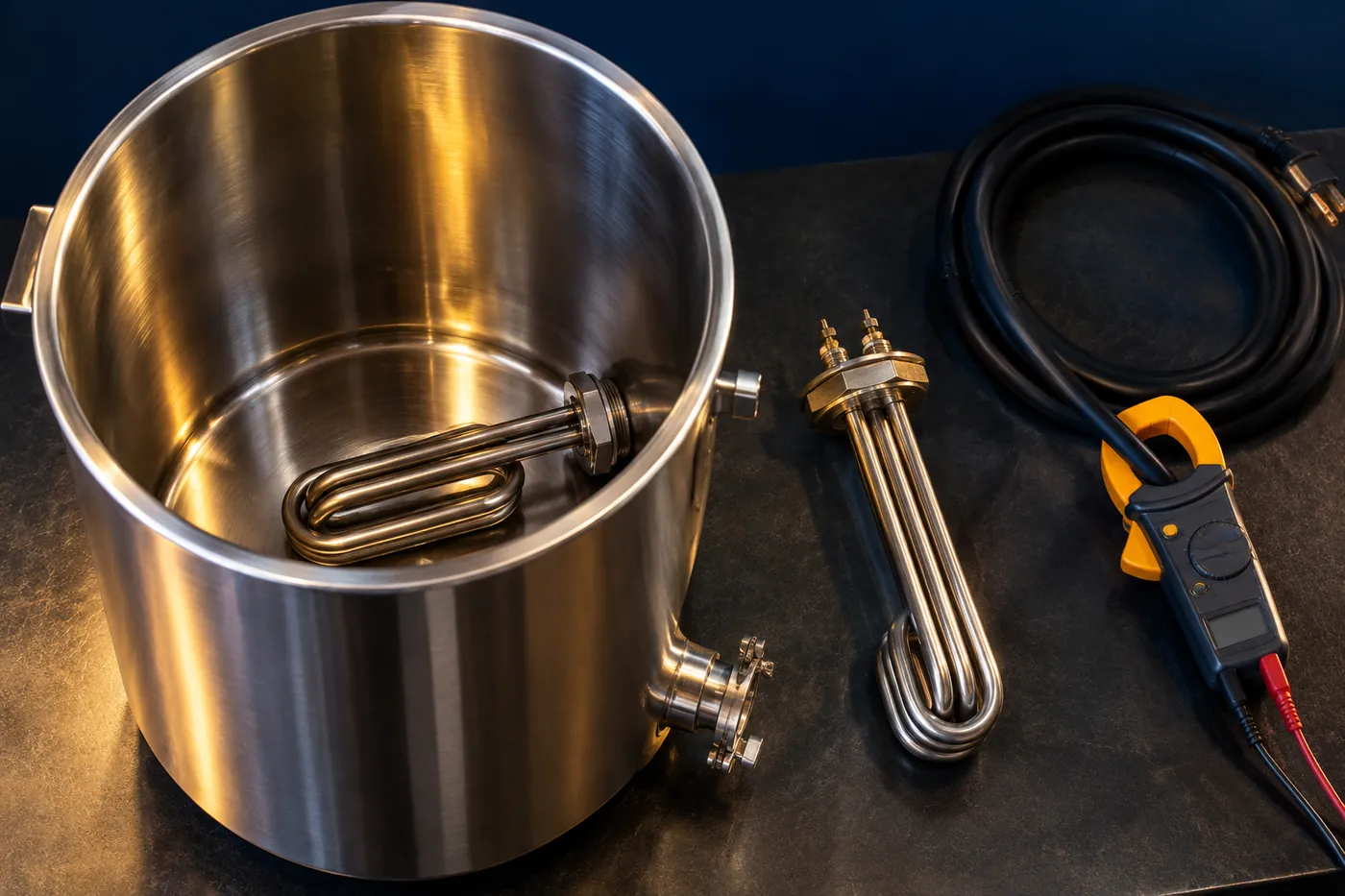
- Use a clamp meter and a voltmeter on a hard-wired element, or a power-monitoring device made for the load.
Mains electricity can kill. Leave any work on fixed wiring or element connections to a qualified electrician, and only ever power an element that is fully submerged.
What your element really delivers
Enter the rating from the label and your supply voltage. Add a wash volume to estimate the heat-up time.
Steady heat
A heating power regulator sets the heat by switching the element on and off very rapidly, delivering a chosen share of the full power. On its own, that share is a share of whatever the supply provides. Add a measurement of the real power and the control can close the loop: if the voltage sags, the regulator delivers a larger share, and the still receives the heat the recipe asks for - up to what the element can give at that voltage. That is one reason to choose an element with some headroom above the heat you normally use.
Where Stilligent fits
Rather than assume, Stilligent measures. The Smart Watchdog reports the actual power, mains voltage and energy used per run; the element's true output is measured at the start of each run; and Stilligent bases its heat control on those measurements. You set the power in kilowatts, and as the mains voltage rises and falls, Stilligent adjusts the element so the still receives the same heat - telling you if the element can't reach the setting. Larger stills can share that power across up to four elements.
Sources and further reading
- IEC 60038: IEC standard voltages (230 V nominal supply), and EN 50160: Voltage characteristics of electricity supplied by public electricity networks.
- ANSI C84.1: Electric Power Systems and Equipment - Voltage Ratings (60 Hz).
From the forum
Questions, corrections or experience of your own? Share them in this guide’s topic on the Stilligent forum.
More guides
-
Methanol in distilling: fact and myth
Where methanol really comes from, why fruit needs care, what distillation does and doesn't do - and the myths that won't go away. 4 min read
-
Inverted sugar: how to make it, and what the acid does to your wash
How to invert sugar properly, what it does and doesn't do for a wash, and how the inverting acid changes your wash's pH - with a calculator. 10 min read
-
Making the cuts: foreshots, heads, hearts and tails
The jar method step by step, how to judge each transition by nose and palate, and the mistakes that cost the most spirit. 7 min read
Underlined terms are explained in the glossary - tap one for a quick definition.