
Inverted sugar: how to make it, and what the acid does to your wash
Inverting sugar is one of the most common steps in home fermentation, and one of the most misunderstood. Done well, it gives the yeast a clean, quick start. But the acid that makes it work stays in your wash - and in a sugar wash, acid is something to measure rather than guess.
In short
- Inverting splits table sugar (sucrose) into glucose and fructose, using a little acid and heat as the catalyst.
- Heat matters more than acid. A gentle simmer inverts most of the sugar in half an hour; held at 80–90 °C, the same syrup is only about half done.
- It does not raise the potential alcohol: the same sugar makes the same ethanol. The gains are a quicker, cleaner start - not a stronger wash.
- The acid is a catalyst, so it isn't used up. Every gram you add for inverting ends up in your wash and lowers its pH.
- If your recipe already contains acid - Birdwatchers, Wineo's, TFFV - use that acid to invert the sugar, and don't add it again.
What inverting does
Ordinary white sugar is sucrose: one molecule of glucose and one of fructose joined together. Inverting breaks that bond, taking up a molecule of water in the process, to leave an equal mix of free glucose and fructose. The name comes from the way the syrup bends polarised light: sucrose turns it one way, the finished mixture the other.
The reaction needs a catalyst. In the kitchen that is acid - citric acid, lemon juice or cream of tartar - with heat to speed it up. Industry also uses the enzyme invertase, and so does yeast: Saccharomyces makes its own invertase and splits sucrose outside the cell before taking the sugars in.
That last point is worth knowing before you start, because it means the yeast will invert the sugar anyway. Laboratory work with ordinary baker's yeast shows its invertase splitting sucrose far faster than the yeast can ferment the result; in a healthy wash, most of the sucrose is split within the first several hours to a day. Pre-inverting does that first step for the yeast, a little earlier.
What inverting does not change - and one thing it does
- The alcohol it can make. One kilogram of sucrose gains about 53 g of water as it inverts, becoming 1.053 kg of glucose and fructose - and either way it can make at most about 538 g of ethanol. The theoretical yield is identical.
- The fermentable sugar. All three sugars ferment completely with any wine, bread or distiller's yeast.
- The gravity reads slightly higher. Glucose and fructose pack a little more densely in solution than the sucrose they came from, so the same sugar can read a few points higher on the hydrometer - perhaps 1.073 instead of 1.070. It holds no more alcohol, so a strength calculated from that gravity comes out a fraction too high. That alone can make an inverted wash look stronger on paper.
Is it worth it?
Often, yes - but for practical reasons, not because it adds alcohol.
- A quicker start. The yeast can begin on glucose straight away, which can trim the lag before fermentation gets going. With a healthy pitch the difference is modest - hours, not days.
- Sugar that is truly dissolved. Undissolved crystals at the bottom of a fermenter ferment late or not at all. A simmered syrup is completely dissolved.
- A clean, sterile addition. The simmer sterilises the syrup, and adding it as syrup makes it easy to measure and mix.
- Possibly a more complete finish. A wash that ferments steadily and finishes dry gives more spirit than one that stalls. Where inverting helps the yeast avoid a stall, it can lift the yield - but a healthy wash that already finishes at about 0.990 has nothing left to gain.
Claims that inverting adds half a percent or a percent of ABV to a wash that would otherwise ferment dry don't survive the arithmetic: the sugar has the same alcohol in it either way. If your washes finish sweet, look first at temperature, nutrients, yeast health and pH.
There is also a subtlety at high gravity. Splitting each sugar molecule into two doubles the number of dissolved molecules, and with it the osmotic pressure the yeast feels at pitching. Because yeast inverts sucrose within hours anyway, it meets that pressure either way - but it is one more reason to stay within your recipe's gravity rather than adding extra sugar.
How to invert sugar
Per kilogram of white sugar (scale up as needed):
| Ingredient | Per kg of sugar | Notes |
|---|---|---|
| White sugar | 1 kg | Granulated or caster. |
| Water | 500 mL | Soft or filtered water if you can; it counts towards the wash's total volume. |
| Citric acid | about 1 g | About ¼ level teaspoon. Or the recipe's own acid - see below. |
| …or lemon juice | about 20 mL | Roughly 1½ tablespoons; about half a lemon. |
- Dissolve. Heat the water in a deep, heavy pan, add the sugar and stir until it has completely dissolved. Use a pan at least three times the syrup's volume.
- Add the acid. Stir in the citric acid or lemon juice.
- Simmer. Bring it to a gentle simmer - a 2:1 syrup simmers at about 104 °C - and hold it there for 30 to 45 minutes. A loose lid limits evaporation. Don't stir once it simmers; brush any crystals down the side of the pan with a wet pastry brush.
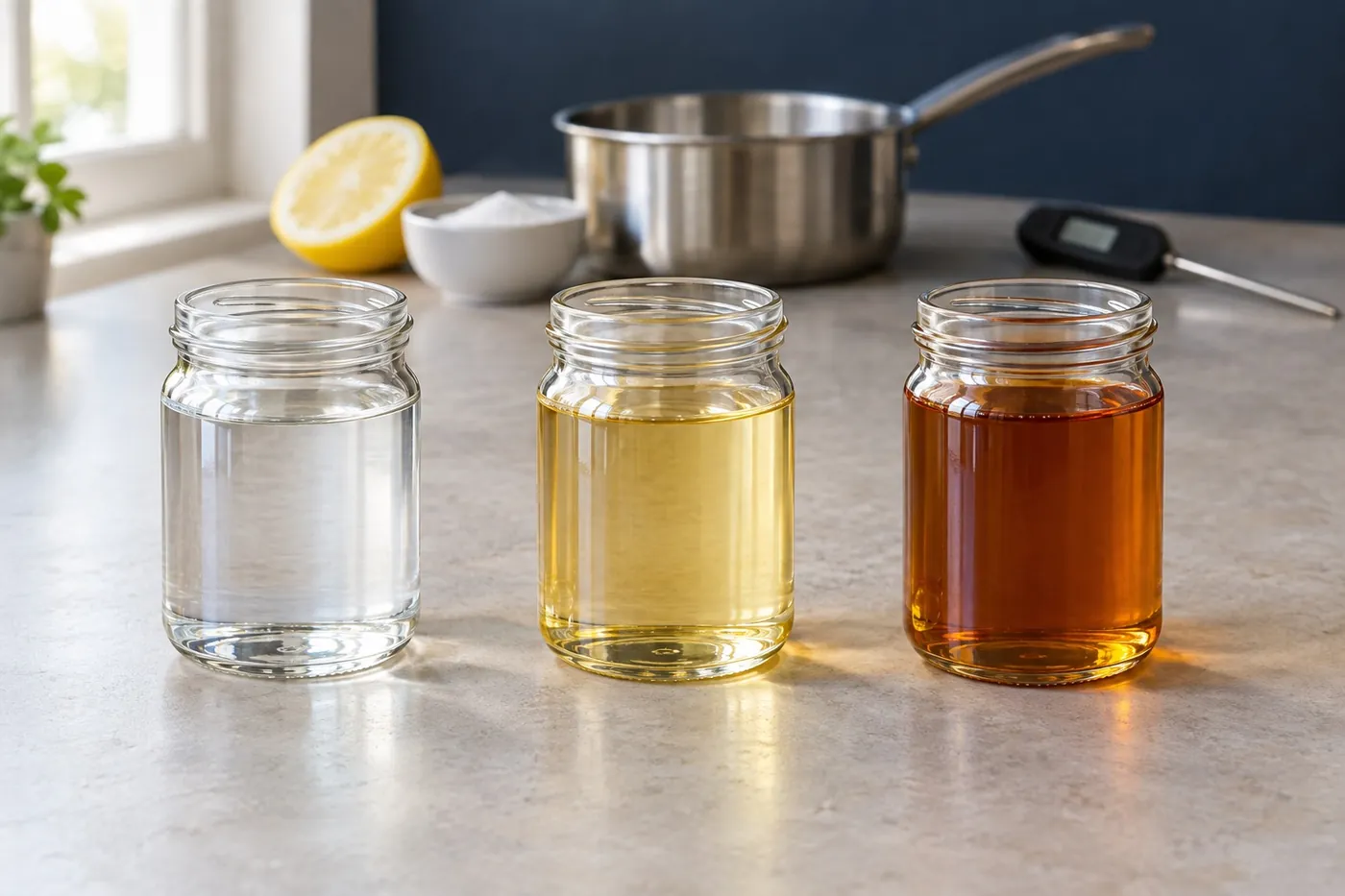
- Watch the colour. A pale straw colour is normal. Amber or brown means it has caramelised: turn the heat down next time.
- Cool and add. Let it cool, then stir it into the fermenter with the rest of the water. Remember that the syrup's water is part of the batch volume.
Hot syrup causes severe burns. It is hotter than boiling water and sticks to skin. Use a deep pan on a back burner, keep children and pets away, never leave it unattended, and let it cool before pouring.
Hotter and longer isn't better. Above about 110 °C, or with a long boil, the sugars begin to brown and form small amounts of compounds such as hydroxymethylfurfural (HMF), which add colour and flavour and, in larger quantities, can slow yeast.
Heat, acid and time
Acid-catalysed inversion follows two simple rules, both well established in the sugar industry:
- The rate is proportional to the acidity. Double the acid, and the sugar inverts about twice as fast - but the extra acid all ends up in your wash.
- The rate rises steeply with temperature. Every 15 °C or so makes it four to five times faster.
So temperature is the better lever. Holding a syrup at 80–90 °C for 20–40 minutes, as many recipes suggest, inverts only part of it; a gentle simmer for the same time inverts nearly all of it, with no more acid.
A simmer does in 20 minutes what 85 °C needs two hours for
1 kg sugar, 500 mL water, 1 g citric acid (estimates)
- Gentle simmer, 104 °C
- Held at 85 °C
Estimates for 1 kg of sugar, 500 mL of soft water and 1 g of citric acid, from published sucrose-inversion kinetics. Real syrups vary - treat the times as a guide, within a factor of about two. Hard water neutralises some of the acid and slows inversion.
The acid and your wash's pH
A question we're often asked. "My recipe calls for a little acid. If I invert my sugar, I'll use three or four times that amount for the inversion. Doesn't the inverting acid change the final pH of the wash?"
Yes, it does. The acid catalyses the reaction without being consumed, and citric acid survives the simmer unchanged. Every gram you add to the syrup ends up in the fermenter, on top of any acid the recipe adds. A calculator that suggests an amount of acid for the wash knows nothing about the acid you used to invert the sugar - so count the two together.
Whether that matters depends on two things: how much acid in total, and how much your water and other ingredients can absorb.
Why sugar washes are sensitive
Yeast ferments best between about pH 4.0 and 5.0, and acceptably from about 3.5 to 6. As it works, it lowers the pH itself - by producing organic acids, by dissolving carbon dioxide, and by releasing acid as it takes up the ammonium in nutrients such as DAP. A grain or molasses wash is rich in natural buffers that resist the change. A sugar wash has almost none, so its pH can fall quickly - and below about 3.5 fermentation slows, while near 3 it often stalls with sugar left unfermented.
So in a sugar wash, a little acid at the start is useful: it brings tap water's pH down into the range yeast likes, and discourages bacteria. Too much leaves no room for the fall that fermentation itself will bring.
How much difference the extra acid makes
The table shows the calculated starting pH of a plain 25 L sugar wash - sugar, water and citric acid only - in soft and in hard water:
| Citric acid in 25 L | Teaspoons | pH, soft water | pH, hard water |
|---|---|---|---|
| None | - | 7–8 | 7.5–8.5 |
| 1.2 g | ¼ tsp | 4.9 | 7.0 |
| 2.3 gBirdwatchers | ½ tsp | 4.0 | 6.7 |
| 4.6 g | 1 tsp | 3.5 | 6.2 |
| 7.0 g | 1½ tsp | 3.3 | 5.8 |
| 9.3 g4 × Birdwatchers | 2 tsp | 3.2 | 5.4 |
Calculated from citric acid's dissociation constants and the water's alkalinity (soft: 20 mg/L as calcium carbonate; hard: 200 mg/L), freshly mixed, at 25 °C. Tomato paste, bran, DAP and other nutrients add buffering, so a real wash usually reads higher.
Two lessons stand out:
- In soft water, extra acid matters. With little alkalinity to absorb it, four times the acid takes a plain sugar wash from about pH 4 to about pH 3.2 - below the comfortable range before the yeast has even begun to lower it.
- In hard water, much of it disappears. The water's alkalinity neutralises the first few grams. As a rule of thumb, every 25 mg/L of alkalinity (as calcium carbonate) absorbs about 1 g of citric acid in a 25 L wash. Your water supplier publishes its alkalinity or hardness figures.
Recipes that already contain acid
The simplest rule: invert the sugar with the acid the recipe already calls for, and leave it out later. Most recipes include enough acid to invert their sugar in a 30–45 minute simmer, and the wash ends up with exactly the acid the recipe intended.
Birdwatchers
½ tsp citric acid, or the juice of 1 lemon, per 25 L · about 0.5 g per kg of sugar
Invert with it. Simmer for the full 45 minutes. The tomato paste adds buffering.
Wineo's
1 tsp citric acid per 22.7 L · about 1.2 g per kg of sugar
Invert with it. That is plenty for a 30-minute simmer.
TFFV
About ½ tsp, added to bring the pH to about 5 · about 0.6 g per kg of sugar
Invert with it, then check the pH once the bran and DAP are in. Add more only if it reads above about 5.5.
All-Bran
No acid in the original
Add about 1 g per kg if you want it inverted. Without acid, little inverts in 30 minutes - the simmer mainly dissolves and sterilises the sugar. The cereal buffers the wash.
Each of these recipes comes with its own calculator, which scales the acid along with everything else. Tick Inverted sugar and it shows how much water to simmer the sugar in, and reminds you to leave the acid out of the wash afterwards.
If you prefer to invert with more acid - to work faster or at a lower temperature - that's fine, provided you leave the recipe's own acid out and check the pH before pitching.
Measuring and correcting the pH
A calculation is a guide; a measurement is an answer. pH test strips covering about 3 to 6, or an inexpensive pH meter calibrated with buffer solutions, are all you need.
- Measure before pitching. Take a sample once the wash is mixed and cooled to room temperature. For a sugar wash, aim for about pH 4.5–5.0 at the start.
- Too low? Raise it with calcium carbonate (precipitated chalk) - a teaspoon at a time per 25 L, stirring and measuring between additions. Chalk is the better choice for a sugar wash: it dissolves only while the wash is acidic, so it is hard to overshoot, and any left over keeps buffering as fermentation acids form. Clean, crushed eggshells do the same job more slowly. Baking soda works faster but adds sodium; to cancel a gram of citric acid completely takes about 1.3 g, so add it sparingly.
- Too high? Above about 5.5, add citric acid a quarter-teaspoon at a time.
- Measure again if it slows. If fermentation slows well before the gravity reaches about 0.995, check the pH. Below about 3.5, a little chalk often gets it going again.
Tip: a pH meter or strip reads a warm or syrupy sample inaccurately. Measure the wash, not the syrup, and at room temperature.
Where Stilligent fits
Stilligent takes over once the wash is in the boiler, so fermentation is yours to manage. A wash that finishes dry and clean is the best start a run can have: setting up a run begins with the wash volume and its starting strength, and a well-fermented wash gives more hearts and cleaner cuts. The recipe calculators estimate both for your batch.
Sources and further reading
- Wikipedia: Inverted sugar syrup - preparation by acid and by invertase, kitchen ratios, and neutralisation with baking soda. en.wikipedia.org
- Studies on the continuous inversion of sucrose: I, research data. Journal of the American Society of Sugar Beet Technologists 17(3), 187–194 - rate proportional to acid, activation energy about 27 kcal/mol, 4.5-fold faster from 85 to 100 °C. PDF
- Oliveira, J. et al.: The influence of pH on the kinetics of acid hydrolysis of sucrose - activation energy 99 kJ/mol, independent of pH; rate proportional to hydrogen-ion concentration. ciencia.ucp.pt
- Sjölin, M. et al. (2024). Investigating the inhibitory factors of sucrose hydrolysis in sugar beet molasses with yeast and invertase. Catalysts 14(5), 330. mdpi.com
- Lallemand: Pinnacle Distilled S product information - optimal pH 4.0–5.0, acceptable 3.5–6.0. PDF
- Murphy & Son: Just Add Sugar - on the lack of buffering in sugar fermentations and the risk of stuck fermentation. PDF
- Penniston, K. L. et al. (2008). Quantitative assessment of citric acid in lemon juice, lime juice, and commercially-available fruit juice products. Journal of Endourology 22(3), 567–570. PubMed
From the forum
Questions, corrections or experience of your own? Share them in this guide’s topic on the Stilligent forum.
More guides
-
Making the cuts: foreshots, heads, hearts and tails
The jar method step by step, how to judge each transition by nose and palate, and the mistakes that cost the most spirit. 7 min read
-
Distilling safely: the hazards and good practice
Flammable vapour, pressure, electricity, heat and the spirit itself: the hazards of a still, and how careful distillers manage them. 6 min read
-
Pot still, reflux still or column: which is right for you?
How pot stills, packed reflux columns and plated columns work, what each does best, and how to choose between them. 4 min read
Underlined terms are explained in the glossary - tap one for a quick definition.