
Distilling safely: the hazards and good practice
A still boils a flammable liquid and turns it into a flammable vapour, a few steps from a source of heat. Most of the time nothing goes wrong - because careful distillers understand the hazards and build habits around them. This guide sets out those hazards plainly, and the good practice that keeps them in check.
In short
- Alcohol vapour is flammable, heavier than air and burns with a flame that can be almost invisible. Keep it away from flames, sparks and heat, and make sure it condenses.
- A still must always be open to the air at its outlet. Never seal it, and keep the vapour path free of blockages.
- Cooling is a safety system: if it fails, vapour escapes uncondensed.
- Treat the electrics with respect: protected circuits, sound connections, and an element that is never powered dry.
- Never leave a running still unattended.
- Distil only where it is legal to do so.
Please read this as general guidance. It is not a substitute for the instructions for your own equipment, for local regulations, or for professional advice - on electrical work in particular. You remain responsible for the safety of your setup.
First, the law
Fermenting a wash is legal in many countries. Distilling it is often a different matter: in many places distilling spirits requires a licence, and in some it is not permitted for private individuals at all. Check the rules where you live before you run a still. Nothing in this guide is legal advice.
Fire: the hazard that matters most
Ethanol gives off flammable vapour at room temperature: pure ethanol at about 13 °C, and spirit at 40% ABV from about 26 °C. Air containing between roughly 3% and 19% ethanol vapour can ignite. Three properties make that vapour more dangerous than it looks:
- It is heavier than air. Escaping vapour sinks and spreads along the floor, where it can find a pilot light, a heater or a spark some distance away - and the flame can travel back along the vapour trail.
- Its flame can be almost invisible in daylight. A small fire at the collection point may not be noticed until something else catches.
- The spirit you collect is fuel. A jar of hearts is a jar of flammable liquid.
Good practice
- Keep naked flames, sparks, smoking and heaters away from the still - and especially from the collection point, where vapour and liquid alcohol are both present.
- Place the receiver well away from the heat source, and keep collected spirit covered.
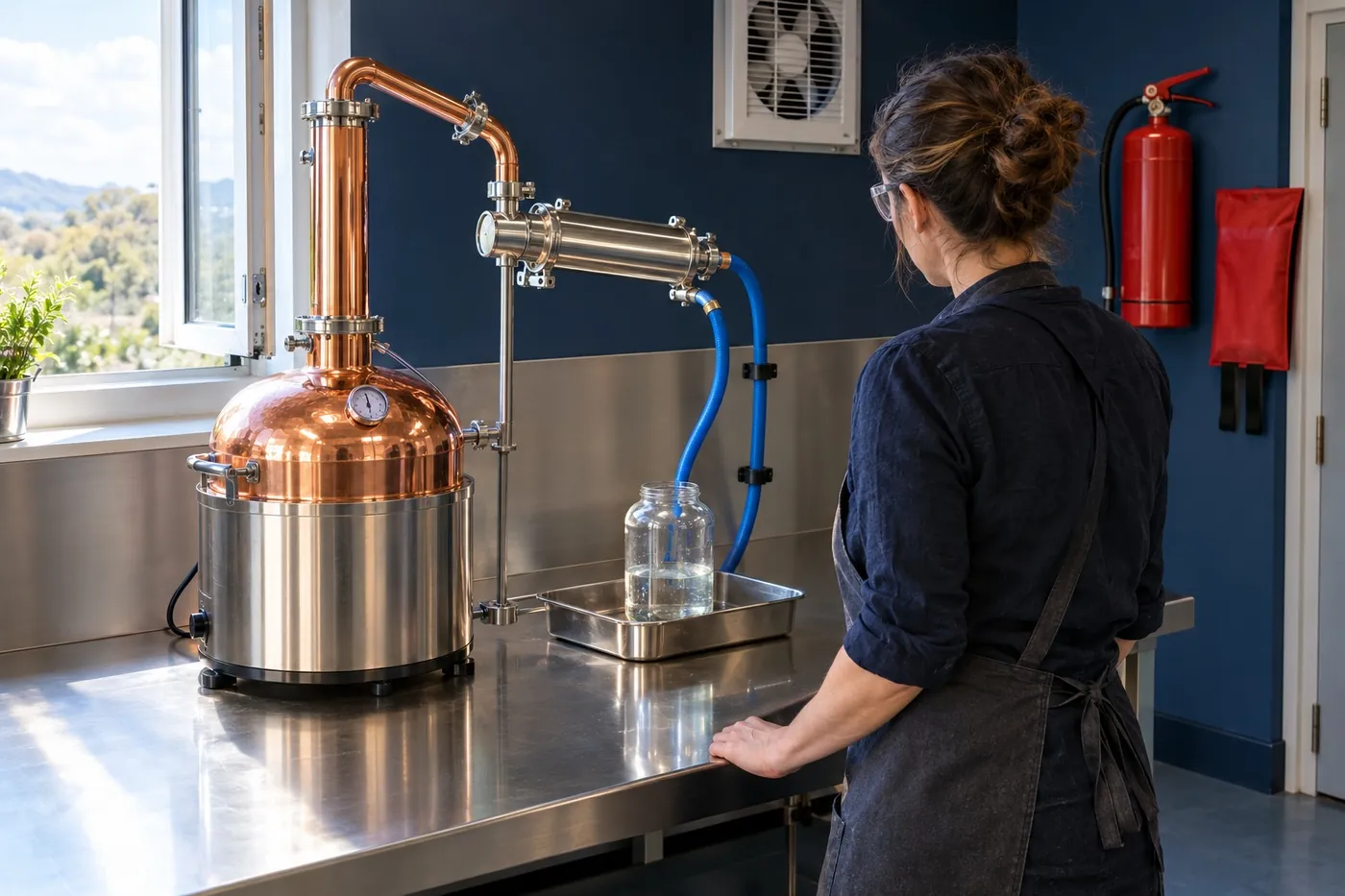
- Keep a suitable extinguisher within reach. For alcohol fires, alcohol-resistant foam, carbon dioxide or dry powder are generally recommended; keep a fire blanket as well. Know how to cut the heat in an instant.
- Clear the area of anything that burns easily, and keep spillages wiped up.
Pressure: never seal a still
A still is designed to run at atmospheric pressure. The vapour must always have a free path from the boiler, through the condenser, to an outlet open to the air. If that path is closed or blocked, pressure builds in the boiler with nowhere to go.
- Never fit an airtight seal to the outlet or the receiver.
- Keep the vapour path clear: check that packing hasn't settled into a plug, and that nothing can drop into a narrow pipe.
- Don't overfill the boiler. A wash that foams or boils over - a "puke" - can carry solids into the column and block it. Leave headroom, and bring grain or fruit washes up to temperature gently.
- Strain solids that could scorch or foam out of the wash before it goes into the boiler, unless your still is designed for them.
Cooling is a safety system
The condenser is what turns flammable vapour back into liquid. If the cooling water stops - a pump fails, a hose kinks, the supply runs out - vapour passes straight through and out into the room.
- Check that cooling is flowing before the still comes up to temperature, and keep checking during the run.
- Distillate should leave the condenser cool. Warm distillate, or a smell of alcohol around the outlet, is a warning to cut the heat and investigate.
- If you recirculate cooling water from a reservoir, make sure it is large enough not to warm up over a long run.
Electricity and water
An electric element is often safer than a flame, because there's no open fire near the vapour - but it brings its own hazards, close to water and conductive metal.
- Power the still from a circuit protected by a residual-current device (RCD, also called a GFCI), with the still earthed.
- Use cables, plugs and leads rated for the element's full current, and avoid long or coiled extension leads under heavy load.
- Never power an element unless it is fully submerged. A dry element overheats rapidly.
- Keep connections and controls away from drips and splashes.
- Leave work on fixed wiring and element connections to a qualified electrician.
Heat, steam and heavy liquids
- A full boiler is heavy and its contents scald. Plan where it will sit before you fill it, and let it cool before moving or emptying it.
- Open lids and fittings away from your face; steam and hot vapour burn.
- Wear sensible clothing and eye protection when handling hot liquids or cleaning chemicals.
Ventilation - during fermentation, too
Ventilation matters for two reasons. While distilling, it disperses any vapour that escapes before it can build up. During fermentation, it clears the carbon dioxide that yeast produces in large volumes. Carbon dioxide, too, is heavier than air and can collect in low or enclosed spaces such as cellars. Ferment and distil somewhere with a good flow of fresh air.
What a still is made of
Everything that touches the wash, vapour or spirit should be food-safe and suited to hot alcohol. Copper and stainless steel are the standard choices. Avoid lead solder, galvanised (zinc-coated) metal, unknown plastics and rubber in the hot vapour path, and anything salvaged that was never meant for food - such as old radiators.
The spirit itself
- Discard the foreshots every time, and never drink them. See making the cuts.
- Understand where methanol comes from, and why fruit washes need particular care: see methanol in distilling.
- Taste only small, diluted samples, never spirit at full strength.
- Label everything you store, keep it away from children, and never add industrial or denatured alcohol to anything you drink.
Stay with it
Most incidents begin with something small - a hose that slips, a receiver that overflows, a cooling supply that runs dry - which becomes serious only because nobody is there to notice. Never leave a running still unattended. Stay within sight and sound of it, and switch it off before you step away.
A checklist before every run
- Legal and prepared. You are permitted to distil where you are, and you have time to stay with the still for the whole run.
- Space. Ventilated, clear of flames, sparks and anything that burns easily. Extinguisher and fire blanket within reach.
- Boiler. Filled with headroom to spare; solids strained where needed; element fully covered.
- Vapour path. Clear from boiler to outlet; outlet open to the air; receiver not sealed.
- Cooling. Flowing before heating starts, with enough capacity for the whole run.
- Electrics. Protected circuit, sound leads and connections, controls dry.
- Collection. Receivers ready and away from the heat; a plan for the foreshots.
Where Stilligent fits
Stilligent can help to improve safety, but it is not a safety device and is no replacement for the measures in this guide. It checks its sensors before and during every run, watches for readings that don't make sense, sounds alerts and alarms on your phone or PC and at the still, and in a critical alarm cuts power to the boiler to help prevent an accident. An independent Smart Watchdog can cut the power even if the controller itself is unavailable.
None of that changes the rule above: never leave a running still unattended.
Sources and further reading
- CAMEO Chemicals (NOAA): ethanol - flash point, explosive limits, vapour density and fire response. cameochemicals.noaa.gov
From the forum
Questions, corrections or experience of your own? Share them in this guide’s topic on the Stilligent forum.
More guides
-
Pot still, reflux still or column: which is right for you?
How pot stills, packed reflux columns and plated columns work, what each does best, and how to choose between them. 4 min read
-
Stripping run and spirit run: why distil twice?
Why pot-still spirits are distilled twice, how each run differs, and how many washes it takes to fill a spirit run. 3 min read
-
Proof and ABV, and how to measure your spirit
ABV, US and British proof, hydrometers and alcoholmeters, temperature correction - and calculators for proof, dilution and wash strength. 3 min read
Underlined terms are explained in the glossary - tap one for a quick definition.