
Proof and ABV, and how to measure your spirit
Every bottle states its strength, but the numbers come in different flavours: ABV, US proof, and the old British proof. Here's what each means, how to measure the strength of your wash and your spirit accurately, and how to dilute to exactly the strength you want.
In short
- ABV is the percentage of the volume that is pure alcohol.
- US proof is twice the ABV. The old British proof is about 1.75 times the ABV.
- Measure a wash with a hydrometer, before and after fermentation; measure spirit with an alcoholmeter. Neither works on the other.
- Readings depend on temperature. Correct to the instrument's calibration temperature.
- When diluting, add water in stages and measure again: alcohol and water shrink when mixed.
ABV: alcohol by volume
ABV is the share of a liquid's volume that is pure ethanol, measured at a standard temperature (20 °C in most of the world). A 700 mL bottle at 40% ABV holds 280 mL of pure alcohol. It is the measure used on labels almost everywhere, and the one to use in your own records.
You may also meet ABW - alcohol by weight. Because ethanol is lighter than water, the ABW of a spirit is lower than its ABV; it's rarely used outside science and some regulations.
Proof: two different scales
US proof is simply twice the ABV: 40% ABV is 80 proof, and 100 proof is 50% ABV.
British proof, used in the UK until 1980, came from an old test: spirit was "proved" if gunpowder soaked in it would still ignite. On that scale 100° proof is about 57.15% ABV, so British proof is roughly 1.75 times the ABV - and 40% ABV is 70° proof. You'll still meet it in older books and on some naval rums.
Measuring a wash: the hydrometer
A hydrometer measures density - specific gravity - not alcohol. Dissolved sugar makes a wash denser; as yeast turns sugar into alcohol, which is lighter than water, the gravity falls. So the strength of a wash comes from two readings: the original gravity (OG) before fermentation, and the final gravity (FG) when it has finished.
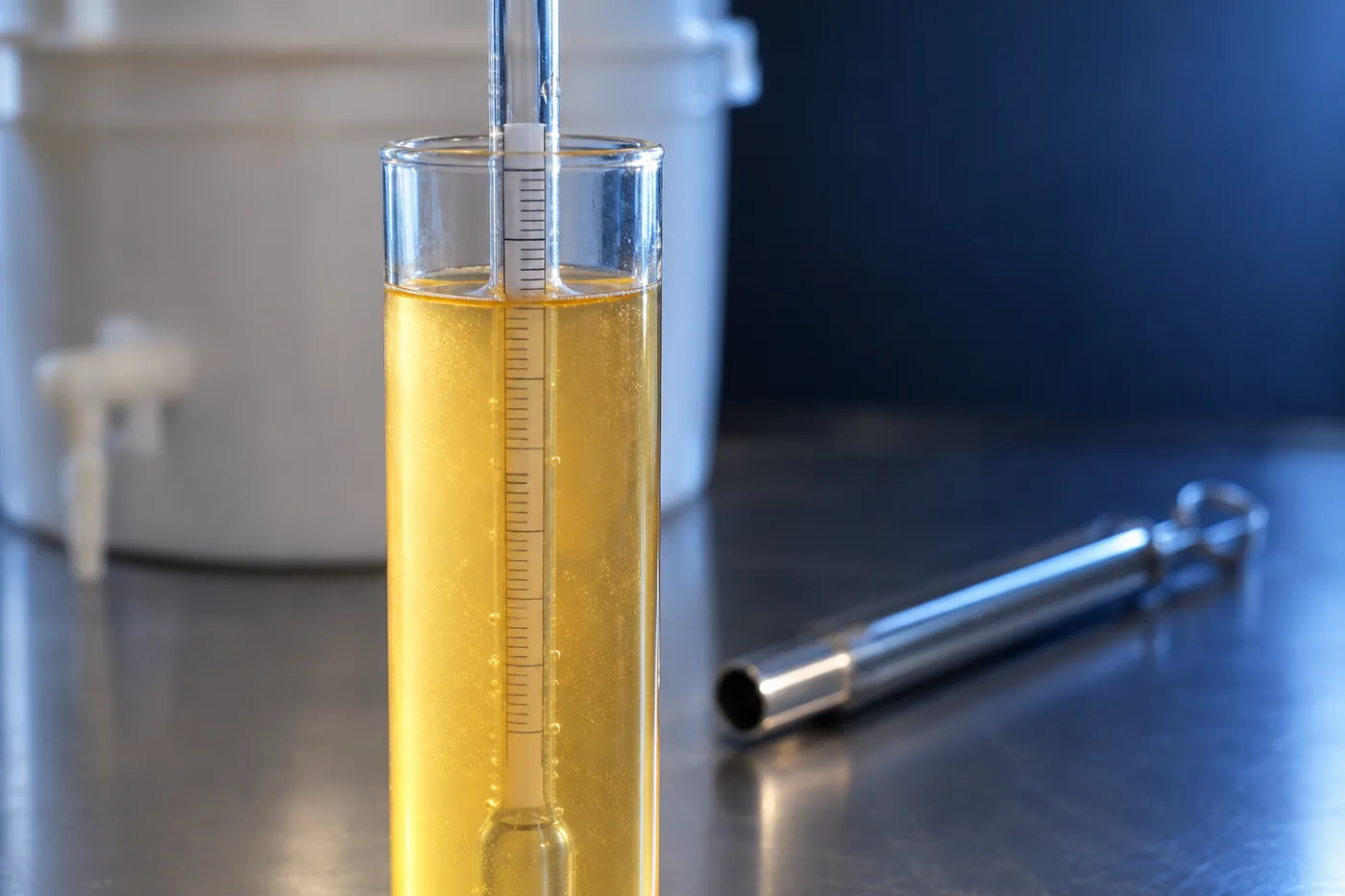
- Take readings in a tall trial jar, with the hydrometer floating freely, and read at the level of the liquid's surface.
- Degas a fermenting sample first: bubbles clinging to the hydrometer push it up.
- Most hydrometers are calibrated at 20 °C (some at 15.6 °C / 60 °F); correct warmer or cooler readings, or cool the sample first.
- A sugar wash typically finishes around 0.990–0.995. Washes with unfermentable solids, such as molasses, finish higher.
Measuring spirit: the alcoholmeter
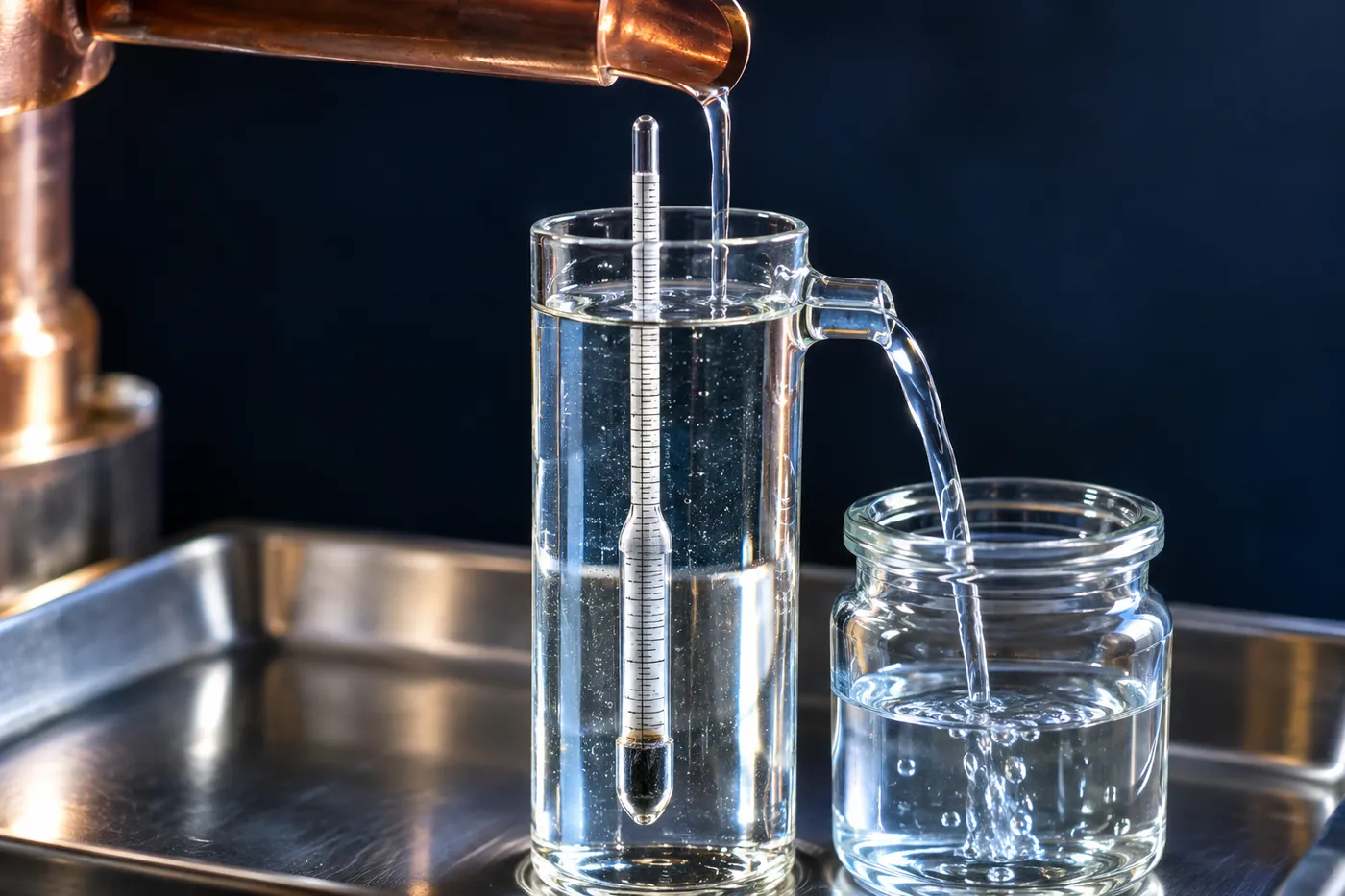
An alcoholmeter looks like a hydrometer but is scaled directly in ABV for mixtures of alcohol and water. It reads spirit straight off the still, a jar of hearts or a finished bottle - but only if there is nothing else dissolved in it. Sugar, as in a wash or a liqueur, makes it read wrong.
- Use a trial jar tall and wide enough for the alcoholmeter to float without touching the sides.
- Spin it gently to dislodge bubbles, and read at eye level.
- Many distillers float one in a small cylinder under the still's outlet - a parrot - to watch the strength of the spirit as it runs.
Correcting for temperature
Alcohol expands more than water when warmed, so a warm sample reads high and a cool one reads low. At drinking strengths the error is roughly a third of a percentage point for every degree away from the calibration temperature - small on one reading, but enough to push a bottle off its label. Use the correction table supplied with your alcoholmeter, or bring the sample to its calibration temperature (usually 20 °C) before reading.
Diluting to bottling strength
Spirit is usually collected well above the strength you want to drink it at, so it needs diluting - "proofing down". Use clean, soft water: distilled, deionised or a low-mineral spring water, since minerals can cloud the spirit.
Where Stilligent fits
Setting up a run in Stilligent starts with the wash volume and its starting ABV. From there it estimates the strength of the spirit as it runs, and records every run - temperatures, cuts, power and energy - so your measurements and notes build into recipes you can repeat.
From the forum
Questions, corrections or experience of your own? Share them in this guide’s topic on the Stilligent forum.
More guides
-
Why a temperature chart can't tell you when to cut
Why stills don't follow the familiar boiling-point charts, what the head temperature really measures, and what it is good for. 5 min read
-
Distilling at altitude: how air pressure moves every boiling point
Why every boiling point falls as you climb, how much the weather moves it, and a calculator for your own elevation or barometer reading. 4 min read
-
Your element isn't the power on the label
How mains voltage changes an element's real output, how to measure it, and why steady heat in watts makes runs repeatable. 4 min read
Underlined terms are explained in the glossary - tap one for a quick definition.