
Why a temperature chart can't tell you when to cut
Search for distilling temperatures and you'll find the same chart everywhere: methanol at 65 °C, ethanol at 78 °C, fusel oils above 100 °C. It looks like a cutting guide. It isn't - and understanding why makes you a better distiller.
In short
- The familiar charts list boiling points of pure compounds. A still boils a mixture, and mixtures behave very differently.
- The temperature at the column head is set almost entirely by the balance of ethanol and water in the vapour. It says little directly about the trace compounds that decide your cuts.
- Nothing in a running still boils off at 65 °C. Methanol is spread through the run; fusel oils appear well before the boiler reaches 131 °C.
- Air pressure, sensor placement and heat input all move the reading, so a number that worked in one place, on one day, won't necessarily work on another.
- Temperature is valuable for trends and for knowing how much alcohol is left. Cuts need it interpreted for your recipe, your still and today's conditions - together with ABV, smell and taste.
The chart you've probably seen
These are the boiling points that circulate on forums and posters. Each is correct - for that compound, on its own, at sea-level pressure.
| Compound | Boiling point (pure) | Where it's usually placed |
|---|---|---|
| Acetaldehyde | 20 °C | Foreshots |
| Acetone | 56 °C | Foreshots |
| Methyl acetate | 57 °C | Foreshots |
| Methanol | 65 °C | Foreshots |
| Ethyl acetate | 77 °C | Heads |
| Ethanol | 78 °C | Hearts |
| 1-Propanol | 97 °C | Tails |
| Water | 100 °C | - |
| Isobutanol | 108 °C | Tails |
| Isoamyl alcohol | 131 °C | Tails |
Read as a cutting guide, the chart suggests that compounds leave the still one after another, in order of boiling point, and that the thermometer tells you which one is coming out. Neither is true.
What actually boils in a still
A wash is mostly water with some ethanol. The congeners are present in tiny amounts, dissolved in that mixture. They don't wait for their own boiling points; each evaporates along with the ethanol and water, in proportion to how volatile it is in that particular mixture.
So the vapour's temperature is set almost entirely by its two main ingredients. A strong liquid boils cooler and gives off strong vapour; a weak one boils hotter and gives off weaker vapour:
Stronger liquid boils cooler
Ethanol–water mixtures at sea-level pressure
| Liquid in the boiler (approx.) | Boils at (sea level) | Strength of the vapour (approx.) |
|---|---|---|
| Water only | 100.0 °C | - |
| 6% ABV | 95.5 °C | 40% ABV |
| 20% ABV | 89.0 °C | 67% ABV |
| 31% ABV | 85.3 °C | 74% ABV |
| 39% ABV | 84.1 °C | 77% ABV |
| 61% ABV | 81.5 °C | 82% ABV |
| 68% ABV | 80.7 °C | 84% ABV |
| 81% ABV | 79.3 °C | 88% ABV |
| 91% ABV | 78.4 °C | 92% ABV |
| 96% ABV | 78.2 °C | 96% ABV |
Ethanol–water equilibrium at 1 atm (Perry's Chemical Engineers' Handbook), converted from mole fractions to approximate ABV. Values are rounded.
In a simple pot still, the vapour reaching the thermometer has roughly the strength shown in the last column, and its temperature is close to the boiling point of the liquid in the boiler. The head temperature is therefore, above all, a reading of how much alcohol is left in the boiler. It rises steadily as the run goes on - whatever trace compounds happen to be riding along.
Notice the bottom of the scale, too. Ethanol and water form an azeotrope at about 96% ABV that boils at about 78.2 °C at sea level. No ethanol–water vapour can be cooler than that.
The methanol myth
If nothing in the vapour can be cooler than about 78 °C, then nothing in a running still comes off "at 65 °C". A head thermometer reading 65 °C is showing a still that is still warming up: the vapour hasn't reached the sensor yet, and it is measuring warm metal and air.
Methanol is highly soluble in water and behaves much like ethanol in the still. Rather than leaving in a neat first burst, it is spread through the run; studies of fruit spirits find it in every fraction, often peaking early in the hearts. Washes made from sugar or grain contain very little methanol to begin with - fruit rich in pectin produces more. Discarding the foreshots is good practice, but the cut cannot remove methanol completely, and no thermometer reading can show that it has.
Fusel oils don't wait until the end
By the chart, isoamyl alcohol shouldn't appear until 131 °C - a temperature a boiler of wash never reaches. Yet fusel oils are in every run. Their behaviour depends on the strength of the liquid around them: in weak, watery liquid they evaporate readily, while in strong spirit they hang back. That is why they collect part-way up a reflux column, and why in a pot still they are present throughout and grow more noticeable as the strength falls, in the tails.
Pot still or reflux still: two different thermometers
The same thermometer tells a very different story on each kind of still.
Same thermometer, different story
Illustrative shapes, not measurements
- Pot still
- Reflux still
On a pot still, the head temperature climbs gradually from start to finish, following the falling strength in the boiler. A given reading corresponds to a given vapour strength, not to a given fraction: the same temperature can fall in the hearts with one wash and in the tails with another.
On a reflux still, the column holds the head close to the azeotrope for most of the run. The temperature barely moves while the flavour changes from heads to hearts. By the time it starts to climb, the column can no longer hold the tails back - they are already on their way. Useful as a warning, too late as a cut signal.
Three things that move the reading
Air pressure
Boiling points fall with altitude - by roughly 1 °C for every 300 m - and shift with the weather by up to about a degree. A temperature that marked the hearts at sea level means something else at 1,500 m. See distilling at altitude, with a calculator for your own location.
The sensor itself
Where the sensor sits, how far it reaches into the vapour path and how well it is calibrated all matter. A sensor in a thermowell reads the vapour rather than the metal around it. Check calibration in iced water, which reads 0 °C almost anywhere; boiling water is only 100 °C at sea-level pressure.
Heat and flow
A slow vapour stream heats the sensor slowly, so readings lag behind the vapour. Heat input changes how fast the boiler is depleted and how the column behaves, so the same temperature can arrive at different points in the run.
What temperature is good for
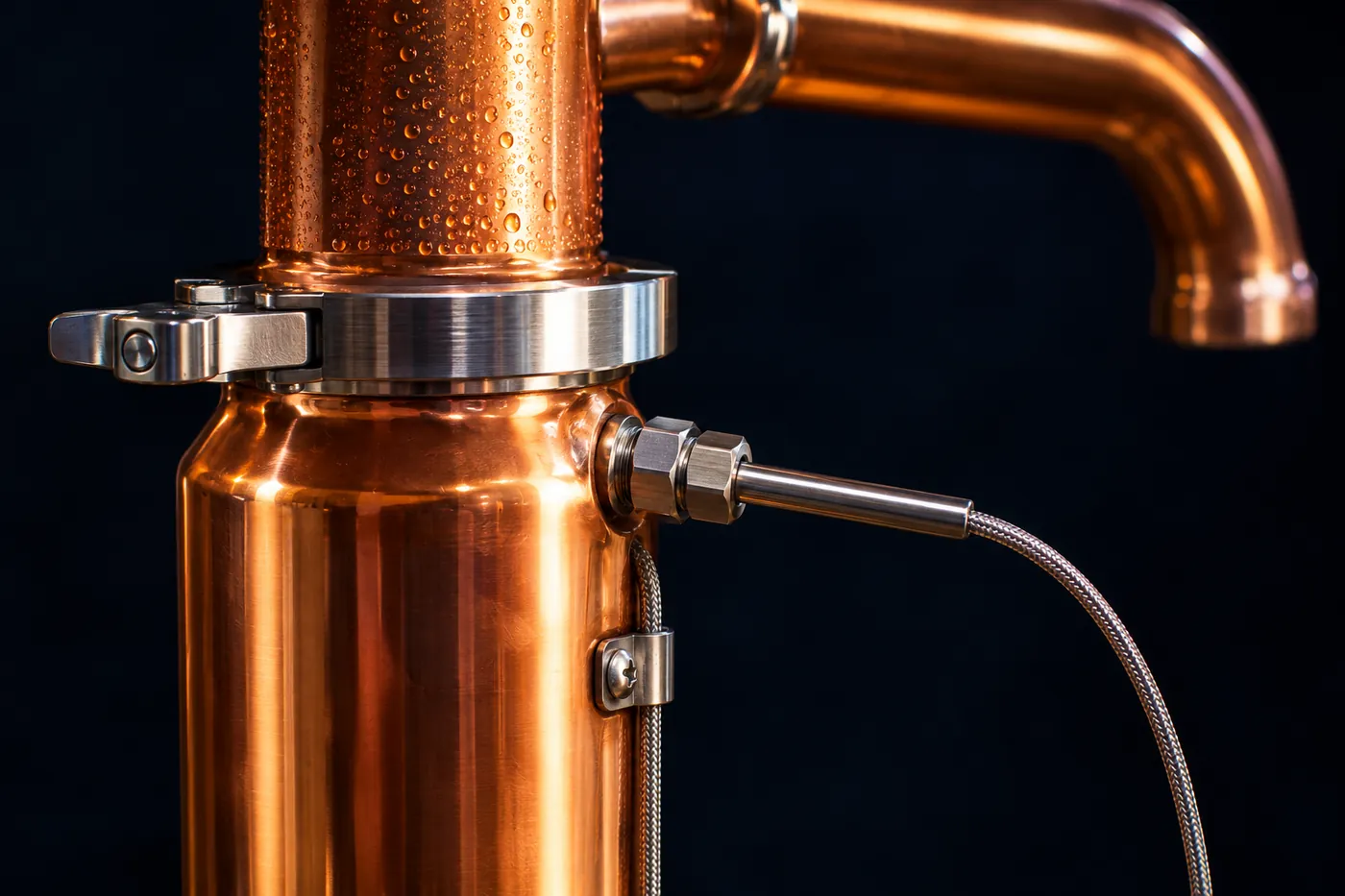
- Knowing where the run is. When vapour reaches the head, the reading jumps; on a pot still, the steady climb tracks how much alcohol remains.
- Spotting change. On a reflux still, a rise is an early warning that the tails are coming.
- Watching the boiler. As the boiler approaches the boiling point of water at your pressure, little alcohol is left - useful for ending a stripping run.
- Repeating a good run. Interpreted for the same recipe, the same still and the same pressure, temperature becomes a dependable reference - alongside ABV, smell and taste.
That last point is the key. Temperature is useful once it is interpreted; a fixed chart can't interpret it for you. For how experienced distillers actually decide, see making the cuts.
Where Stilligent fits
Stilligent reads the temperature at the column head and in the boiler - but never against a fixed chart. It keeps cut points for each of your recipes, adjusts every threshold to your local air pressure and to the strength of the wash, and refines the recipe each time you move a cut by nose and palate. A number, given its meaning.
Sources and further reading
- Green, D. W. and Southard, M. Z. (eds.). Perry's Chemical Engineers' Handbook: vapour–liquid equilibrium data for ethanol–water at 101.3 kPa.
- Stoica, F. et al. (2020). Volatile compounds in different fractions of fruits distillate obtained by traditional distillation. Scientific Bulletin, Series F: Biotechnologies, XXIV(2). PDF
- NIST Chemistry WebBook: phase-change data for ethanol. webbook.nist.gov
From the forum
Questions, corrections or experience of your own? Share them in this guide’s topic on the Stilligent forum.
More guides
-
Distilling at altitude: how air pressure moves every boiling point
Why every boiling point falls as you climb, how much the weather moves it, and a calculator for your own elevation or barometer reading. 4 min read
-
Your element isn't the power on the label
How mains voltage changes an element's real output, how to measure it, and why steady heat in watts makes runs repeatable. 4 min read
-
Methanol in distilling: fact and myth
Where methanol really comes from, why fruit needs care, what distillation does and doesn't do - and the myths that won't go away. 4 min read
Underlined terms are explained in the glossary - tap one for a quick definition.