
Making the cuts: foreshots, heads, hearts and tails
Where you draw the lines between foreshots, heads, hearts and tails shapes a spirit more than almost anything else you do on the day. This guide explains how experienced distillers make their cuts - jar by jar, by nose and by palate - and why the same still can need different cuts from one run to the next.
In short
- What comes out of a still changes gradually. The cuts divide it into foreshots (discard), heads and tails (set aside as feints) and hearts (keep).
- Collect the run in many small, numbered jars, so you can decide afterwards with a rested nose instead of in the moment.
- Judge diluted samples by smell and taste, supported by ABV readings and notes. Temperature shows the trend; on its own it doesn't tell you where to cut.
- Run gently. Steady, moderate heat separates the fractions more cleanly and makes every cut easier.
- Good cut points depend on the recipe, the still and the day. Write down what you did, and next time starts from your best run instead of from scratch.
What you're separating
A wash is mostly water and ethanol, plus small amounts of hundreds of other compounds made during fermentation - the congeners. Some are unpleasant, some carry the flavour you want, and they leave the still at different stages of the run. Nothing switches over abruptly: one fraction fades as the next grows. The four names are a practical way of dividing a continuous stream.
| Fraction | What it's like | What to do with it |
|---|---|---|
| Foreshots | The first portion. A sharp, solvent smell, like nail-polish remover. | Discard. Never drink it. |
| Heads | Fruity, sweet and solvent-like at once; hot and harsh on the palate. The harshness fades as the hearts approach. | Set aside as feints for a later run. |
| Hearts | Clean, sweet and rounded - the spirit you set out to make. | Keep. |
| Tails | Strength falling; earthy, oily, wet-cardboard notes from fusel oils. | Set aside as feints for a later run. |
- Foreshots Discard
- Heads Feints
- Hearts Keep
- Tails Feints
Cuts are about quality, not a safety guarantee. Methanol does not leave the still in one neat burst at the start. Studies of fruit spirits find it spread through the run, often peaking early in the hearts. Washes made from sugar or grain contain very little of it; fruit rich in pectin produces more. Discarding the foreshots is sound practice, but no cut removes methanol completely.
Before the run
Jars
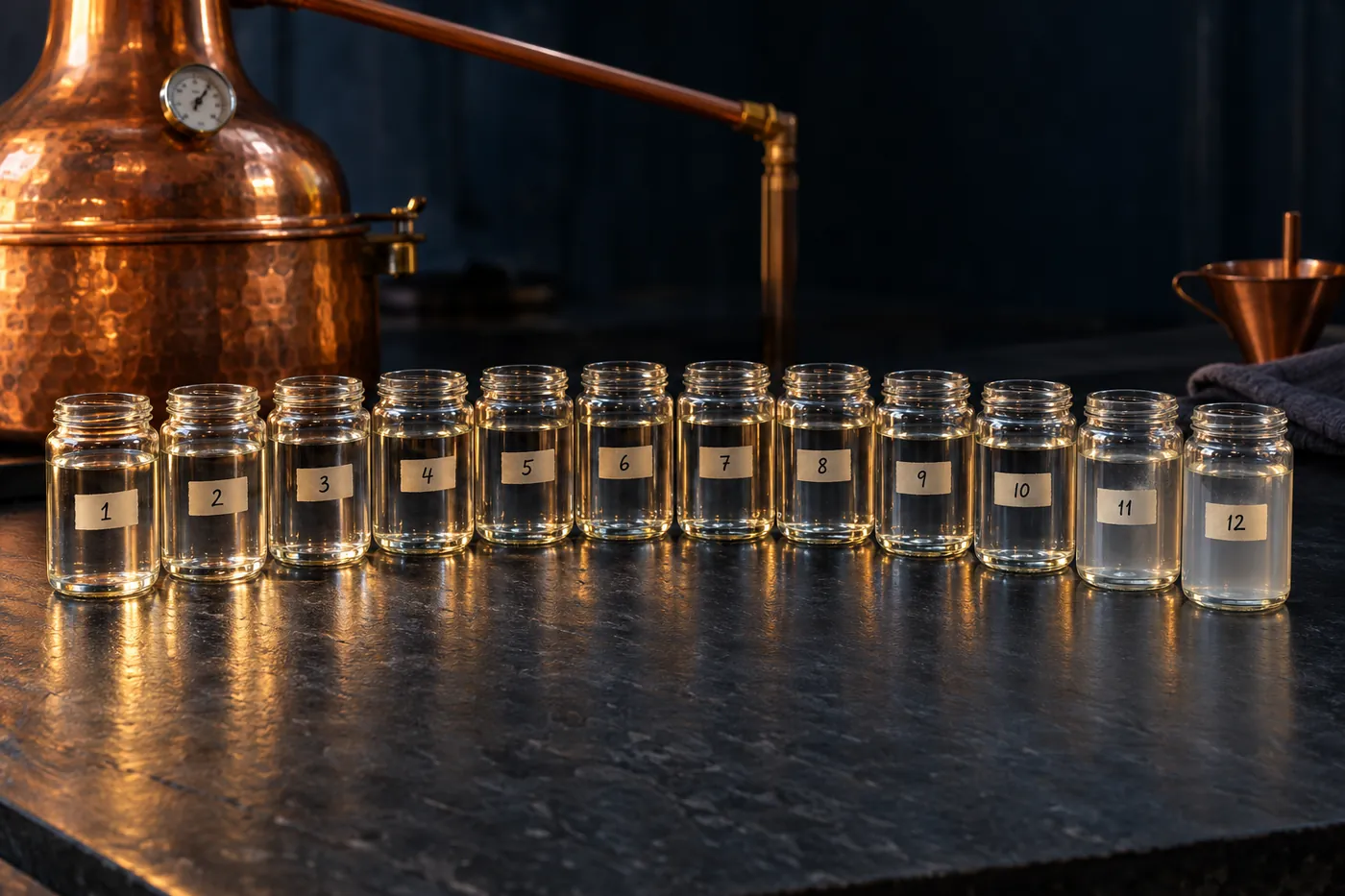
Collect into clean glass jars of equal size, numbered in order. Choose a size that will give you roughly 20 to 30 jars across the run: small enough that each jar is a narrow slice of it, large enough to keep the work manageable. For a run expected to yield around five litres, 250 mL jars work well; larger runs suit larger jars.
Measuring
An alcoholmeter and a narrow trial jar let you read the strength of each jar. Note the liquid's temperature as you read, because most alcoholmeters are calibrated at 20 °C and need correcting away from it.
Notes
For every jar, record the number, the time, its ABV and the temperature at the column head. Add a word or two on smell as you go. These notes turn one good run into a recipe you can repeat.
Stripping and spirit runs
If you distil twice, the careful cutting happens in the spirit run. A stripping run is about recovering alcohol quickly, so nearly everything is collected together as low wines - although many distillers still discard a small foreshots fraction from the stripping run as well.
The jar method, step by step
- Bring the still up gently. Heat at full power to warm the boiler, then reduce well before the first distillate appears, so the run starts at a steady trickle rather than a surge. On a reflux still, let the column settle under full reflux for a while - commonly 20 minutes to an hour - so the most volatile compounds gather at the top before you draw anything off.
- Collect and discard the foreshots. Collect them slowly. How much to discard depends on the wash and the still: one widely used reflux-still guide suggests about 150 mL from a 25 L wash. Err on the generous side; it costs very little spirit. Keep the foreshots well apart from anything you will drink, and dispose of them safely.
- Collect the rest of the run in numbered jars. Change jars at the same volume each time and log every one. Don't try to decide where the hearts begin while the still is running.
- Hold the heat steady through the middle of the run. Speed is the enemy of a clean cut: more heat pushes fractions together, so the heads linger and the tails arrive early.
- Watch for the tails, and keep collecting. The ABV begins to fall more quickly, the smell turns earthy, and the distillate may look oily or turn cloudy when diluted. Collect a few jars well into the tails; you'll decide later, and they are valuable feints.
- End the run. Stop collecting when the jars no longer hold anything worth running again, then switch off the heat.
- Air the jars. Cover them loosely with a paper towel or cloth and leave them overnight - 12 to 24 hours is typical - somewhere well ventilated, away from flames, sparks and heat. The most volatile notes escape, and the jars smell truer the next day.
- Judge and blend. Dilute a small sample from each jar to drinking strength or below. Starting from the best jars in the middle, add neighbouring jars one at a time, tasting as you go, and stop when the blend gets worse. Mark which jars you kept.
- Record the result. Note which jars made the cut, their ABV and head temperature, and the conditions of the day. That record is the starting point for the next run.
Alcohol vapour is flammable. Collect and air your jars in a well-ventilated space, away from naked flames, sparks and heat sources, and never leave a running still unattended. Never taste foreshots, and never taste spirit at full strength.
Judging each transition
Foreshots to heads
The sharp, solvent smell recedes and fruity, sweet-solvent notes take over. The spirit is still hot and harsh, but it no longer smells like a chemical.
Heads to hearts
The most important cut. The harsh edge drops away; the smell becomes clean, sweet and rounded, and the taste is smooth, with no more burn than its strength explains. Smell from a little distance rather than plunging your nose into the glass - alcohol vapour numbs the sense of smell quickly.
Hearts to tails
The sweetness fades and earthy, wet-cardboard notes appear, sometimes described as "wet dog". The mouthfeel turns oily, a diluted sample may cloud, and the ABV falls more steeply from jar to jar.
Your nose tires quickly. Work in short sessions, rest between jars, and reset by smelling something neutral, such as the back of your hand. Compare neighbouring jars side by side rather than judging each one alone.
Different spirits, different stills
There is no single right cut. The same wash can be cut tightly for one spirit and generously for another.
- Neutral spirit, such as a vodka or a base for gin, is cut tightly at both ends: any character from the heads or tails counts as a fault.
- Whiskey and rum usually take wider cuts. A little of the late heads adds fruit; a little of the early tails adds body. Spirit destined for a barrel can carry more, because ageing softens it.
- Fruit brandies owe much of their aroma to the late heads, so the first cut is made with particular care.
The still matters too. A pot still separates gently, so its transitions are broad zones of judgement. A reflux still separates sharply: the hearts run at high, steady strength, and the tails arrive quickly once the column can no longer hold them back. Our guide to temperature charts explains why the thermometer behaves so differently on each.
Common mistakes
- Too much heat. A fast run smears the fractions together and narrows the hearts.
- Cutting by a number from a chart. Boiling points shift with the recipe, the still and the air pressure. See why a temperature chart can't tell you when to cut and distilling at altitude.
- Deciding in the moment. Without jars, every decision is final. With them, you can change your mind tomorrow.
- Tasting undiluted spirit. At full strength everything tastes hot, and the differences you are looking for disappear.
- Throwing away good feints - or adding foreshots to them.
- Rushing the airing. Jars judged straight off the still mislead.
- Not writing it down. The notes are what make the next run better.
What to do with the heads and tails
Heads and tails still hold a good deal of ethanol. Keep them together as feints in a sealed, clearly labelled container, stored somewhere cool and away from heat, and add them to a later spirit run with the low wines. Many distillers find that adding feints over several runs builds depth and character. The foreshots never go back in.
Where Stilligent fits
Stilligent keeps cut points for each of your recipes and adjusts them to the conditions of the day - the air pressure and the strength of the wash in the boiler. It eases the heat through the hearts for cleaner separation and alerts you when it's time to change receivers. One tap makes a cut by nose and palate; if a suggested cut comes too early, Not yet keeps collecting. Every cut you make - and the jars you end up blending - is recorded, and the recipe moves gently towards your choices after each run.
Your judgement still has the final say. You can override any cut at any time, and cut detection is a guide to separation and quality; it does not confirm what is in the collected spirit.
Sources and further reading
- Stoica, F., Muntean, C., Giugea, N., Mărăcineanu, L. and Ionete, R. (2020). Volatile compounds in different fractions of fruits distillate obtained by traditional distillation. Scientific Bulletin, Series F: Biotechnologies, XXIV(2). PDF
- KegLand. Making and distilling a wash (reflux still user guide). docs.kegland.com.au
From the forum
Questions, corrections or experience of your own? Share them in this guide’s topic on the Stilligent forum.
More guides
-
Distilling safely: the hazards and good practice
Flammable vapour, pressure, electricity, heat and the spirit itself: the hazards of a still, and how careful distillers manage them. 6 min read
-
Pot still, reflux still or column: which is right for you?
How pot stills, packed reflux columns and plated columns work, what each does best, and how to choose between them. 4 min read
-
Stripping run and spirit run: why distil twice?
Why pot-still spirits are distilled twice, how each run differs, and how many washes it takes to fill a spirit run. 3 min read
Underlined terms are explained in the glossary - tap one for a quick definition.