
Distilling at altitude: how air pressure moves every boiling point
Every temperature on a still depends on the air pressure around it. Distil high above sea level, or on a stormy day, and the whole run shifts - the same spirit, at different numbers. Here is how much, and what to do about it.
In short
- Boiling points fall as air pressure falls. Ethanol boils about 1 °C lower for every 300 m of altitude; water slightly more.
- Weather moves them as well - by up to about a degree either way at any one place.
- Use the actual pressure where you are. Weather reports give pressure corrected to sea level, which is the wrong number for a still above it.
- At altitude, boiling water reads below 100 °C. That's physics, not a faulty thermometer.
- Temperatures from books, forums and charts assume sea level. Adjust them - or better, let your own records and your senses guide the cuts.
Why pressure matters
A liquid boils when the pressure of its own vapour matches the pressure of the air pressing down on it. Lower the air pressure and that point is reached at a lower temperature. The air thins as you climb, so everything boils cooler: the wash in the boiler, the vapour at the column head, and every reference point in between.
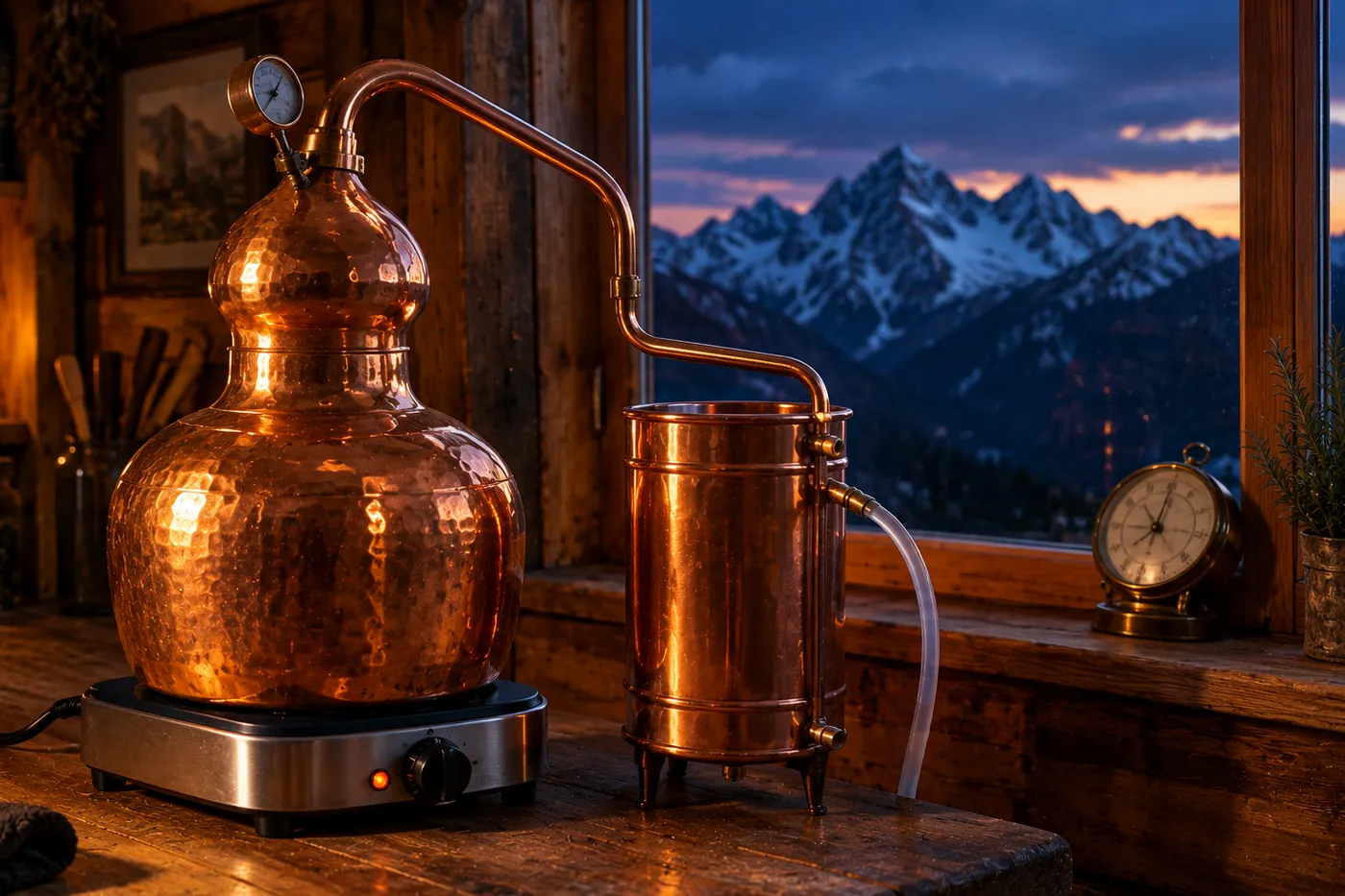
The whole run moves down together. The order of events and the character of the spirit stay much the same; what changes are the numbers on the thermometer.
Boiling points where you are
Enter your elevation, or a barometer reading of the actual pressure at your still.
Boiling points by elevation
Under standard conditions, the boiling points of pure ethanol and water fall like this:
Every 300 m, about 1 °C lower
Pure compounds, standard atmosphere
- Water
- Ethanol
| Elevation | Typical air pressure | Ethanol boils at | Water boils at |
|---|---|---|---|
| 0 m (0 ft) | 1,013 hPa | 78.3 °C | 100.0 °C |
| 500 m (1,640 ft) | 955 hPa | 76.8 °C | 98.3 °C |
| 1,000 m (3,281 ft) | 899 hPa | 75.3 °C | 96.7 °C |
| 1,500 m (4,921 ft) | 846 hPa | 73.8 °C | 95.0 °C |
| 2,000 m (6,562 ft) | 795 hPa | 72.3 °C | 93.3 °C |
| 2,500 m (8,202 ft) | 747 hPa | 70.8 °C | 91.7 °C |
| 3,000 m (9,843 ft) | 701 hPa | 69.3 °C | 90.0 °C |
| 3,500 m (11,483 ft) | 658 hPa | 67.8 °C | 88.3 °C |
Standard atmosphere; Antoine equations from the NIST Chemistry WebBook. Mixtures of ethanol and water shift by a similar amount.
The weather moves it too
Air pressure at any one place rises and falls with the weather. Each 10 hPa changes the boiling point of ethanol by about 0.25 °C. Day-to-day changes are often a few hectopascals; a deep low or a strong high can shift the pressure by 20 to 30 hPa from average - moving every boiling point by the best part of a degree.
That may sound small, but on a reflux still, where the head temperature hardly changes through the hearts, a fraction of a degree is the difference between "still in the hearts" and "the tails have started".
Sea-level pressure is the wrong number. Weather services report pressure corrected to sea level, so that maps from different places can be compared. At 1,500 m the forecast may say 1,013 hPa while the air around your still is nearer 850 hPa. Use a barometer reading of the actual (station) pressure - many phones have a pressure sensor - or enter your elevation in the calculator above.
What it means in practice
Checking a thermometer
Iced water reads 0 °C almost regardless of altitude, which makes it the better check. If you also use boiling water, compare against the water boiling point for your elevation in the table above, not against 100 °C. "Correcting" a thermometer that reads 95 °C in boiling water at 1,500 m would put every later reading out by five degrees.
Temperatures you read elsewhere
Figures in recipes, books and forums almost always assume sea level. Subtract your offset before using them - and treat them as approximate even then. Our guide to temperature charts explains why.
Your own records
Note the air pressure with every run. A cut you made at a particular head temperature on a high-pressure day will sit slightly higher than the same cut on a stormy one. With pressure in your notes, runs on different days become comparable.
Stripping runs and the end of a run
Boiler temperatures used to decide when to stop shift too: at 2,000 m, water boils at about 93 °C, so a boiler of nearly spent wash never reaches the temperatures quoted for sea level.
Does altitude change the spirit?
Very little. How cleanly a still separates the fractions depends on how volatile each compound is relative to ethanol, and that barely changes over the range of pressures anyone distils at. A recipe that works at sea level works in the mountains; it simply runs at lower temperatures.
A few practical details do shift:
- Heat-up is a little quicker. At 2,000 m a typical wash boils about six degrees cooler, so bringing it to the boil from room temperature takes roughly 8% less heat.
- The condenser works slightly harder. The vapour condenses at a lower temperature, so there is a little less difference between it and the cooling water. A condenser that was marginal at sea level may need more flow.
- Every reference temperature moves. Alarms, cut points and end-of-run temperatures set for one location need adjusting at another.
Where Stilligent fits
Stilligent adjusts every threshold to your local air pressure, taken from an optional sensor, an online weather service, a phone's own sensors, a reading entered by hand, or simply your altitude. The cut points in your recipes stay right as the weather changes - and if you move, they move with you.
From the forum
Questions, corrections or experience of your own? Share them in this guide’s topic on the Stilligent forum.
More guides
-
Your element isn't the power on the label
How mains voltage changes an element's real output, how to measure it, and why steady heat in watts makes runs repeatable. 4 min read
-
Methanol in distilling: fact and myth
Where methanol really comes from, why fruit needs care, what distillation does and doesn't do - and the myths that won't go away. 4 min read
-
Inverted sugar: how to make it, and what the acid does to your wash
How to invert sugar properly, what it does and doesn't do for a wash, and how the inverting acid changes your wash's pH - with a calculator. 10 min read
Underlined terms are explained in the glossary - tap one for a quick definition.