
Uncle Jesse's Simple Sour Mash (UJSSM)
Cracked corn, sugar, water and yeast - then the same corn bed, fed with fresh sugar and a share of the spent wash, again and again. Uncle Jesse's Simple Sour Mash needs no cooking and no mashing skill, which is why it has introduced so many home distillers to corn whiskey.
- Makes
- Corn whiskey
- Still
- Pot still
- Ferment
- 3–4 days a generation
- Wash
- about 8–9% ABV
- Difficulty
- Easy
About this recipe
Uncle Jesse adapted the method from J. W. Walstad's book Simple Sour Mash to Simple Alcohol Fuel!, refined it over years of use and shared it as the cheapest way he knew to make corn whiskey - ideal for beginners, because it needs no cooking and no mashing skill. He used it for years before moving on to cooked mashes.
The corn is not cooked, so it converts to sugar only slowly. It contributes a little alcohol but mostly flavour; the sugar provides most of the strength. The character comes from the sour mash: from the second generation on, part of the spent wash from the still - the backset - goes back into the fermenter with fresh sugar, building flavour and consistency. In Uncle Jesse's experience it reaches its peak by the third or fourth run.
Ingredients and calculator
Distiller's yeast if you can get it; the yeast bed then carries over from one generation to the next.
Method
- Load the fermenter. Put the ingredients into the fermenter in the order listed - water, corn, sugar, yeast - and close it. Fermentation should begin within 12 hours.
- Ferment the first, sweet mash. It takes 3 or 4 days for the bubbling to end.
- Siphon and charge the still. Siphon the wash off with a racking cane, leaving the corn and the lees undisturbed: you don't want suspended solids in the still.
- Keep the yeast alive. While the still runs, put the next generation's water back into the fermenter - three-quarters of the volume if you use 25% backset - so the yeast bed isn't left dry. Scoop the spent corn off the top and replace it with an equal volume of freshly cracked corn.
- Decide on your backset. The legal minimum for a sour mash is 25% backset; Uncle Jesse doesn't go above 50%. At 25%, this batch takes 4.75 L of backset and 14.25 L of water.
- Start the second fermentation. Dissolve another full measure of sugar in the backset - hot backset dissolves it more easily, but let it cool before it goes in, or it will kill the yeast. Add it to the fermenter to bring the volume back to the full batch. Ferment another 3–4 days, until the bubbling ends.
- Repeat. Each time, siphon off, distil, return the water, then the backset and sugar. Replace spent corn as it floats to the top; this matters most if you keep going beyond seven or eight generations, when the original corn would otherwise be used up.
Fermentation
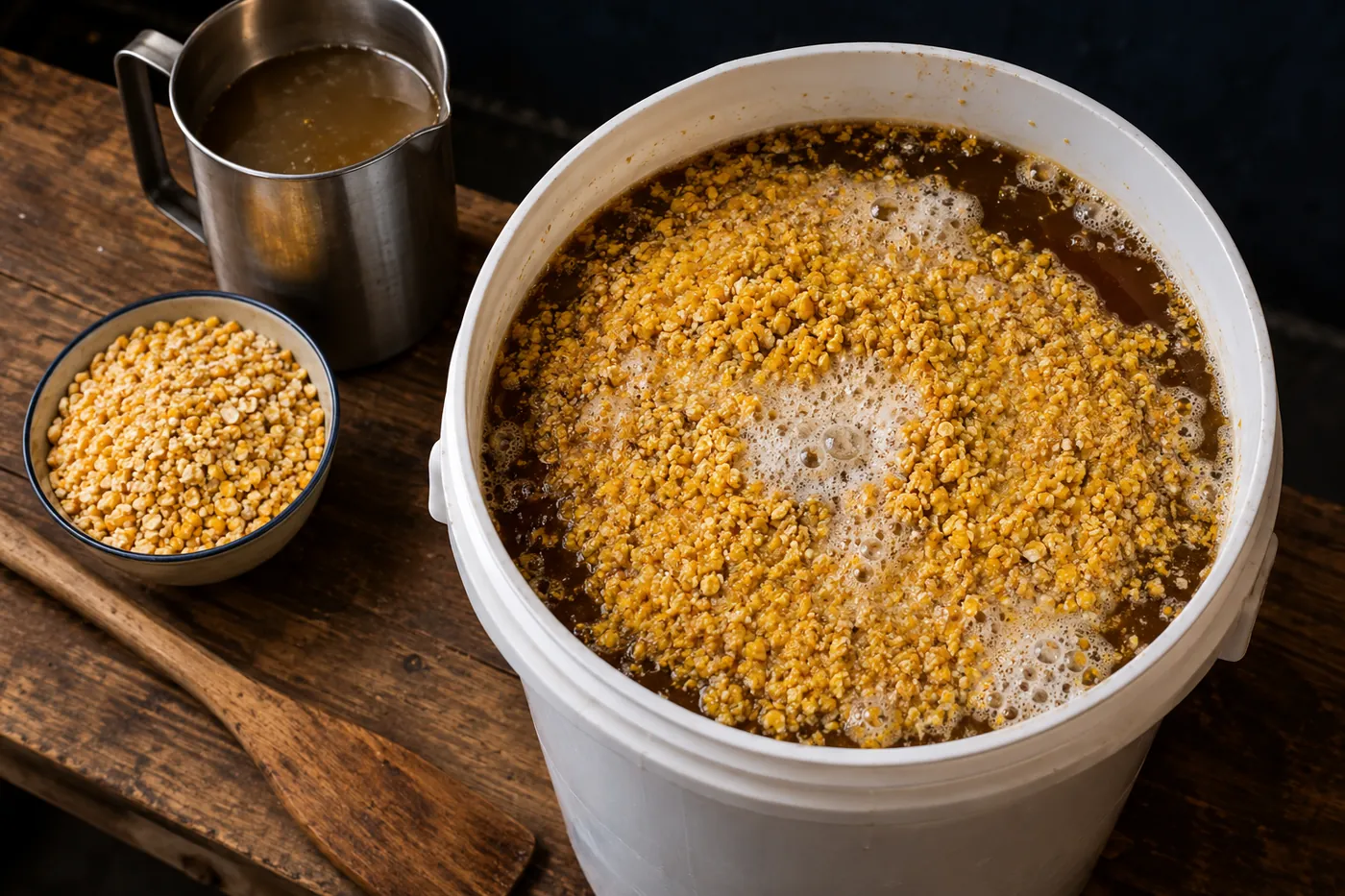
The first run is a sweet run, with no backset. Uncle Jesse recommends using everything collected from it as feints for the next run. The second run produces the first true sour mash, and flavour and consistency keep improving to the third and fourth.
Distilling
Run the pot still slowly: for beginners, 2–3 drops a second from the worm is about right. Discard the first 150 mL every run, so unwanted volatile compounds don't build up from batch to batch. Taste as you go - 4–5 drops in a spoon with the same amount of water - and you'll quickly learn the off-taste of the heads.
For the first runs, Uncle Jesse suggests conservative whiskey cuts, from about 80% down to 70% ABV, going deeper - into the 60s - as your palate improves. Anything above 80% he keeps as feints, since spirit distilled that high is too light to carry the grain's flavour. Many distillers keep collecting down to about 20% for feints. If blue or green flecks appear in the spirit, you have gone too far or run too hot.
It makes a palatable moonshine straight from the still. Aged in an uncharred oak barrel, it becomes a traditional Tennessee-style whiskey. See also making the cuts.
Fermenting a wash is legal in many places; distilling it often is not. Distil only where it is legal to do so, and check your local licensing first.
Troubleshooting
A generation is sluggish or stops early.
Too much backset makes the wash too acidic. Stay between 25% and 50%, and make sure the backset has cooled before it goes in.
Blue or green flecks in the spirit.
A sign of running too far into the tails or too hot. Ease the heat and stop sooner.
The spirit tastes thin.
Give it time: the early generations are the lightest. The third and fourth are where UJSSM comes into its own.
Variations
- Strip and spirit runs. Some distillers strip each generation in a pot still - discarding about 100 mL of foreshots and running down to 20% - save the low wines, and do a slow spirit run once enough has built up. One popular version for 40 L uses 7 kg of corn and 7 kg of sugar, replaces a third of the corn each time, and dissolves each new 7 kg of sugar in 10 L of hot backset.
- Some malt, rye or wheat in place of part of the corn changes the character.
Rate this recipe
Made it? Tell other distillers how it turned out.
Ratings are anonymous. You can change yours at any time.
From the forum
Made it, or have a question about it? Start the conversation in this recipe’s topic on the Stilligent forum.
More recipes
-
Whiskey
Sweet feed whiskey
Molasses-coated livestock grain and sugar: an easy, smooth whiskey from a feed-store sack.
Pot still -
Whiskey
NChooch's Carolina bourbon
An all-grain corn and malted-barley mash, cooked, converted and aged on new charred oak - a true bourbon-style whiskey.
Short column, about 80% -
Whiskey
Cornflakes whiskey
Breakfast cornflakes and sugar: a sweet, full corn whiskey for anyone who can't get good corn.
Pot still, strip and spirit run
Underlined terms are explained in the glossary - tap one for a quick definition.