
About this recipe
Kentucky shinner developed this version from an old-timer's recipe - Deb Brewer's "genuine" moonshine, made with all-grain horse feed, sugar and bread yeast - and "bumped it up a little" for more alcohol per run. The sugar provides most of the strength; the feed gives a sweet, rounded, slightly rummy character that smooths quickly on oak.
For other batch sizes, a good rule of thumb is equal parts sweet feed and sugar: about 0.18–0.21 kg of each per litre of water (1½–1¾ lb per gallon), adjusted to the gravity you want.
Ingredients and calculator
Ordinary bread (baker's) yeast.
Method
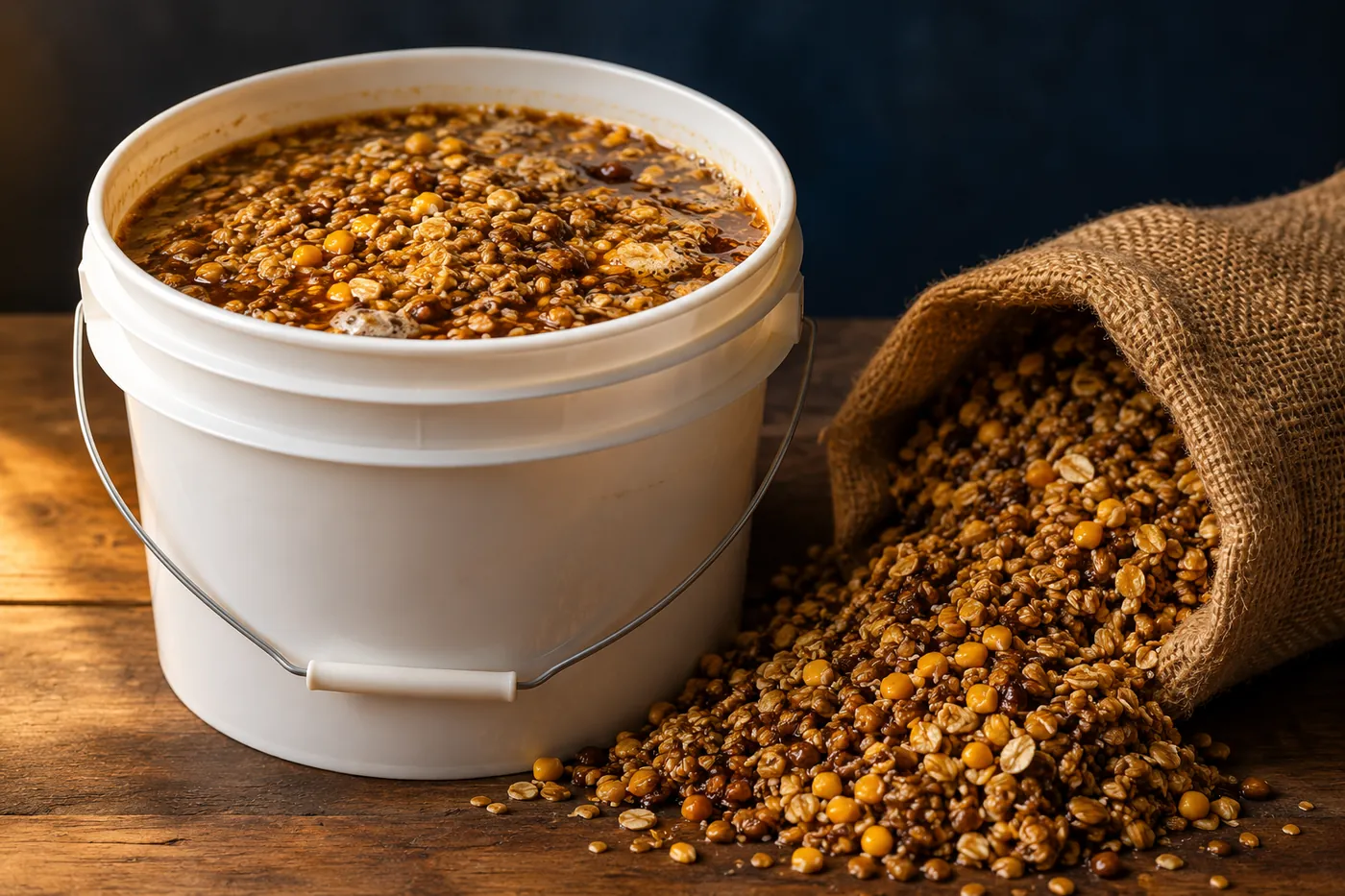
- Choose the feed. Any farm-supply store sells sweet feed. Read the label: choose one without medication or preservatives, which can harm you or stop the yeast.
- Scald the feed. Bring about a third of the water - 7.6 L - to a good, hard boil and pour it over the feed in the fermenter.
- Add the sugar. Add the sugar and stir for about 15 minutes, then let it stand for 90 minutes.
- Top up. Fill to the full volume with cool water. The wash should now be at about 32 °C (90 °F).
- Pitch the yeast. Sprinkle the yeast over the surface and stir gently. Fit the lid and an airlock.
- Ferment. It's usually bubbling within 4–6 hours, runs hard for about two days, then slows right down. Leave it about 5 days - sometimes 6 - until it starts to clear.
- Settle and rack. Stand it somewhere cool for about 24 hours, then rack it off the grain and distil.
Fermentation
A fast start and a vigorous two days are normal; after that it ticks over slowly until it begins to clear. From a batch this size, Kentucky shinner typically collects about 3.8 L of low wines.
Distilling
Run it through a pot still - the original uses one, sometimes with a thumper. Discard the foreshots and collect in jars. The middle of the run can be good enough to drink as it is; most of it improves greatly on oak. Kentucky shinner oaks it at 55% ABV and finds it really smoothing out after a couple of months.
Fermenting a wash is legal in many places; distilling it often is not. Distil only where it is legal to do so, and check your local licensing first.
Troubleshooting
Fermentation won't start.
Check the temperature was down to about 32 °C before pitching, and that the feed has no preservatives.
Grain in the boiler.
Rack carefully after the cool settling day. Solids scorch on an element and can foam into the still.
Variations
- Sour mash. After a run, take about half the hot backset and dissolve another 3.2 kg of sugar in it. Let it cool to about 32 °C, pour it back onto the grain and yeast left in the fermenter, and top up with water to the full volume. The yeast usually wakes within 4–5 hours.
- The original. Deb Brewer's version uses about 4 inches of feed in a 5-gallon bucket, 5 lb of sugar and one packet of bread yeast, filled with warm water and run after 4–5 days.
Rate this recipe
Made it? Tell other distillers how it turned out.
Ratings are anonymous. You can change yours at any time.
From the forum
Made it, or have a question about it? Start the conversation in this recipe’s topic on the Stilligent forum.
More recipes
-
Whiskey
Uncle Jesse's Simple Sour Mash (UJSSM)
Cracked corn and sugar, re-fermented generation after generation with backset. Simple, cheap, and better with every batch.
Pot still -
Whiskey
NChooch's Carolina bourbon
An all-grain corn and malted-barley mash, cooked, converted and aged on new charred oak - a true bourbon-style whiskey.
Short column, about 80% -
Whiskey
Cornflakes whiskey
Breakfast cornflakes and sugar: a sweet, full corn whiskey for anyone who can't get good corn.
Pot still, strip and spirit run
Underlined terms are explained in the glossary - tap one for a quick definition.