
SBB's all-molasses rum
No added sugar - just molasses, a little vitamin B and Epsom salts, baker's yeast, and a measure of hot dunder from the last run. Saltbush Bill has made his rum this way for years and more than fifty generations, and it scales from a single fermenter to 180 litres.
- Makes
- Rum
- Still
- Pot or plated column
- Ferment
- 5–7 days
- Wash
- about 9–10% ABV
- Difficulty
- Easy
About this recipe
Saltbush Bill gathered the ideas behind this rum from many other rum recipes and refined them over four or five years. What sets it apart is that it uses no added sugar at all: it is 100% molasses, so it suits distillers with access to plenty of good-quality, inexpensive stock-feed or blackstrap molasses.
From the second wash on, 4 L of very hot dunder - the liquid left in the still after a run - replaces the boiling water. Sticking to that amount, Bill has never had to adjust the pH in more than fifty generations, though your water may behave differently.
Ingredients and calculator
Lowan's or another baker's yeast, pitched fresh every time.
Method
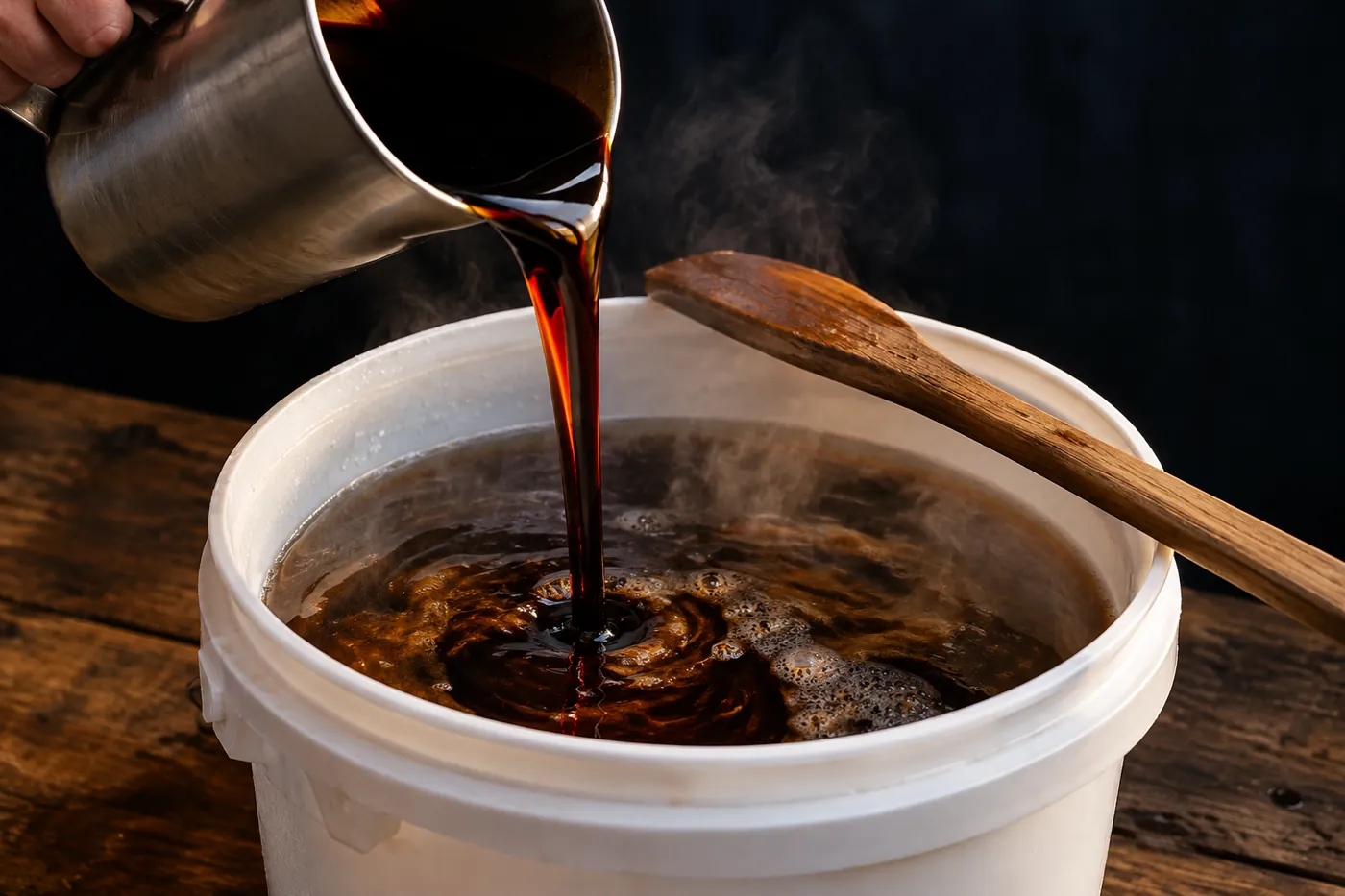
- Molasses first. Pour the molasses into the fermenter.
- Dissolve it. Tip in the boiling water - or, after the first wash, the very hot dunder - and stir until the molasses has completely dissolved.
- Add the nutrients. Add cold water to around 25 L, then the vitamin B and Epsom salts. Bill adds the vitamin B only at this point, as too much heat may destroy it.
- Top up. Top up with cold water to 27–28 L. The wash should be at about 35–38 °C - warm, but within what baker's yeast can handle.
- Pitch fresh yeast. Throw in a good handful of baker's yeast. Activity should start within an hour, and by the next morning it should be going hard.
- Ferment. In warm weather it's done in 5–7 days, sometimes sooner; don't worry if it occasionally takes longer.
Fermentation
Bill doesn't use gravity readings with molasses washes - he judges by taste. When it has stopped fizzing, tastes dry and has a sour edge, it's done; if it still tastes sweet, it isn't. The gravity figures in the calculator are only rough guides, as molasses varies widely.
He always pitches new yeast: hot dunder poured onto the old yeast bed kills it, turning it into nutrients for the fresh yeast. You can add cold dunder and let the old yeast bed carry on instead, but the fermentation starts more slowly and is less vigorous.
Distilling
Bill sometimes single-runs the wash through four plates; other times he strips a wash or two and charges the still with one-third low wines to two-thirds wash. Both give good results. At the end of each run he strips well down into cloudy tails; those low wines, with the heads and tails cut from the run, go into the boiler next time.
Cuts: hearts only, occasionally venturing into the very slightly heads and tails jars - he doesn't like headaches or the taste of tails. Whether you keep more is your choice.
Oak: it's rough off the still, better after three months on oak, better again at six, and keeps improving past a year. Bill prefers medium-toast American oak - dominoes or home-toasted sticks - and avoids char (smoky) and French oak (too sweet for his taste), using roughly one stick of ¾ × ¾ × 6 inches per litre.
Fermenting a wash is legal in many places; distilling it often is not. Distil only where it is legal to do so, and check your local licensing first.
Troubleshooting
Is it finished?
Taste it. Dry and slightly sour means done; still sweet means not.
It's slow to start.
Check the yeast is fresh and the wash isn't far above 38 °C. With cold dunder on the old yeast bed, a slower start is normal.
Variations
- Scale it. Bill has made it from 28 L up to 180 L; it scales without trouble.
- Molasses and sugar. For a lighter rum, see Pugi's rum.
Rate this recipe
Made it? Tell other distillers how it turned out.
Ratings are anonymous. You can change yours at any time.
From the forum
Made it, or have a question about it? Start the conversation in this recipe’s topic on the Stilligent forum.
More recipes
-
Rum
Pugi's rum (Pugirum)
Molasses, brown sugar and a boiled “yeast bomb”, fermented in a day and a half - with saved rum oils for a full, heavy rum.
Pot still: fast strips, gentle spirit run -
Rum
Buccaneer Bob's silver, gold and black rum
Blackstrap molasses, live dunder and a sugar feed, double pot-distilled - then finished silver, gold or black from one batch.
Pot still, strip and spirit run -
Rum
Captain Morgan–style Spiced Gold
Brown-sugar rum steeped on toasted oak, cinnamon, ginger and cloves: a golden spiced rum in the Captain Morgan style.
Underlined terms are explained in the glossary - tap one for a quick definition.